Saturday, August 10, 2013

MAN UP


“And for those who resist that idea that we should think about something like these ‘stand your ground’ laws, I just ask people to consider if Trayvon Martin was of age and armed, could he have stood his ground on that sidewalk? And do we actually think that he would have been justified in shooting Mr. Zimmerman, who had followed him in a car, because he felt threatened? And if the answer to that question is at least ambiguous, it seems to me that we might want to examine those kinds of laws.” 
Barrack Obama - President of the United States

“The attorney general fails to understand that self-defense is not a concept, it’s a fundamental human right. To send a message that legitimate self-defense is to blame is unconscionable, and demonstrates once again that this administration will exploit tragedies to push their political agenda.”
Chris Cox - Executive Director of the NRA-ILA


While it is unlikely that the Obama quote is intended as an endorsement of Trayvon Martin’s right to stand his ground, it does call into question the hypocrisy of the implementation of the law. But does the statement, perhaps unintentionally, play into the narrative that Trayon Martin was, and black men (teens, boys) in general are, a potential threat? Whether self-defense is a “concept” or a “right” or some other thing yet undefined by the narrative, the basis for Stand Your Ground laws is FEAR. Fear that one is under threat becomes the motivating factor for using deadly force and more importantly the deciding factor in determining whether that deadly force was warranted. Who is controlling this fear narrative and what is there to gain from it? I have seen the Obama and NRA statements presented in the media as two sides of an argument, but they seem strangely congruent to me in that they both focus on self-defense, rather than on violence or justice. Imagine for a moment how the case might be different if Trayvon Martin were 5 years of age when he was shot and killed rather than 17. Would the Obama statement still make sense if the boy who was shot was clearly incapable of defending himself from a violent assault - incapable of standing his ground? Does the burden of guilt shift here? And to whom does it shift? Are our laws written to protect this boy’s life or to protect the one who takes that life?

The circular logic of this “self-defense” (fear) narrative sees individuals as monsters, violent by nature, incapable of reason, justifying a violent (“defensive”) response. Through this logic, even if Trayvon Martin felt threatened by Zimmerman and acted in self-defense (which would have to be be proven, not simply assumed to be true), Zimmerman’s violent response would still be warranted. It is through this logic that a trial to determine Zimmerman’s guilt or innocence in the shooting of Trayvon Martin is transformed into a case determining the guilt or innocence of the boy who was shot dead. Has Stand Your Ground circumvented presumption of innocence in this case, effectively making Zimmerman judge, jury and executioner? What crime has Trayvon Martin committed here? Unlike other interpretations of self-defense law where an individual must be in imminent danger, it would seem that the Stand Your Ground law in Florida may accept a provoked assault (the person claiming to have acted in “self-defense” has actively provoked the confrontation) as justification for the use of deadly force.

Three things come to mind:

One) The gun industry stands to profit regardless of how this scripted narrative plays out, whether young black men are cast as the threat or they are made to feel that they are under threat. As I pointed out in an earlier post - presenting the narrative as a conflict (cynically capitalizing on existing racial tensions) ultimately serves to reinforce the perception that gun owners are under attack, and strengthens any defensive argument the gun lobby makes. The righteous indignation that follows serves as validation of what I believe is essentially a coldly calculated business decision. Escalating violence and fear insures repeat customers, and the weapons industry is happy to sell to both sides of the conflict. This isn’t about “gun control,” it’s about violence. This isn’t about “self-defense,” it’s about justice.

Two) The NRA did NOT (through intensive lobbying and campaign contributions) create Stand Your Ground to fill some sort of self-defense law void as one might be led to believe. Self-defense law has been common throughout the United States for more than a century. The main difference in these new laws is an expansion of the justified use of deadly force outside of one’s home (the so called Castle Doctrine) to any place that one is legally allowed to be, removing the duty to retreat and codifying civil immunity for the person using this force. In other words, the shooter cannot be sued for damages in a civil lawsuit so long as they are not found guilty of homicide. It remains to be seen if this new legislation will provide civil immunity in cases where victims’ families pursue legal action seeking damages from the gun manufacturers themselves, similar to cases brought against the tobacco industry in the past.

Three) The common presentation of Castle Doctrine as defense of one’s home (someone breaking into your home is clearly up to no good!) seems misleading to me. This perspective seems to shift the purpose of the law from defending one’s life to defending one’s property. Will “self-defense” under Stand Your Ground ultimately be applied to property in the way that personhood rights have been applied to corporations? What does the Libertarian defense of the right to bear arms look like in this context? Are they fighting for liberty or to secure immunity for those who would steal it from them? As more and more of our public spaces and resources become privatized, we should be vigilant not to allow the “protection of property” to trump our civil rights.

In my previous post I noted how the term “looters” and other similar terms have been used time and again to dismiss the legitimate concerns of people in need, to vilify those that rise up against social and economic injustice. Those who struggle against oppression must be cast as a malevolent force in order to make a defensive response seem reasonable. If they can be successfully cast as a threat, then their oppression appears warranted - the narrative presents this action not as a choice but as a necessary defensive response. When faced with the dualistic framework of fight or flight, there really is only one acceptable option encoded into our (USA) culture - to stand your ground. The mass incarceration of young black males fits into the “self-defense” narrative as a strategy to keep blacks off the streets and off the voter rolls. But it is an offensive strategy as well, generating enormous profit through prison development and maintenance, while supplying cheap labor (less than a dollar an hour) to participating corporations. Are these young men being sold into slavery?
 
Occupy Wall Street was relentlessly attacked in the media on two fronts, cast as a dangerous threat while being simultaneously marginalized as a bunch of do-gooder trust fund kids with nothing better to do than camp out complaining about their first world problems. The first strategy clearly relates to what I stated prior having been widely used as justification for the forced eviction of Occupy camps, but the second strategy is related as well. One of the central tenets of an OWS occupation is that everyone is welcome to speak, and all voices are honored, no matter what their viewpoint is. This is in stark contrast to a status quo that reinforces conformity by punishing us if we stand out, if we make waves, if we “complain” about (resist) our circumstance. Through the narrative of personal responsibility (another popular one), individuals are made to feel that their problems are theirs alone to deal with. If the problems are too much for them to handle individually, then they are at fault; they are weak, lazy, or unwilling to do what is necessary. Pull yourself up by your bootstraps, quit your whining and man up! When individuals get together to share what is on their minds they commonly find that others share their concerns and circumstance, that they are not alone. Through this process we can let go of the idea that our problems must compete for attention, that we must prioritize at the expense of the minority, that we must do battle for the limited resources that are left after most of the pie has already been eaten. We find out that solidarity is not a threat to our individuality but an ally; allowing us to support one another, and be supported, for who we truly are. Most importantly, we can push back against the idea that one must agree with the majority or already be in a position of power to feel justified in speaking out. This knowledge is dangerous, dangerous to the status quo, because it has the potential to redefine the narrative.


Sık bakalım, sık bakalım
Biber gazı sık bakalım
Kaskını çıkar, copunu bırak
Delikanlı kim bakalım

Shoot it at me, shoot it at me
Shoot some pepper gas at me
Doff your helmet, down your baton
Then we’ll see who’s ready to flee


When I first heard this chant/song in Liberty Square it was explained to me as a call for the Turkish police to put down their armor and weapons and join the protestors - a test of their standing as “real men.” What is interesting to me about it is that it seems to celebrate resistance in the face of oppression as a measure of masculinity rather than the machismo that we associate with the concept of “real men” in the United States. I have seen this sentiment brought forward in communities seeking to deal with violence; older men teaching younger men that true strength is not measured through force or dominance, but through taking responsibility for one’s community, as a caretaker for one’s brothers and sisters. I don’t believe the Turkish chant is concerned with self sacrifice, as we seem so obsessed with in our culture, but with an understanding that true freedom cannot be taken away by force and cannot be threatened by oppression.

I had a conversation with a police officer in my dentist’s waiting room the other day. He was talking to me about his son, explaining that he had to be hard on him to prepare him for the adversity that he would encounter later in life. He seemed pretty convinced that this was the only course of action available to him. Here again, as in the self-defense narrative, the action (reaction) appears as a necessary defensive response rather than an actual choice. I inquired, as tactfully as I could manage, if he could somehow change the situation his son would be exposed to (rather than change his son to suit the situation), would he prefer to have a different type of interaction with his son? Perhaps he could choose to be his son’s ally rather than a stand in for a future adversary?

I am reminded of this passage from Brené Brown’s book Daring Greatly:

“The perception that vulnerability is weakness is the most widely accepted myth about vulnerability and the most dangerous. When we spend our lives pushing away and protecting ourselves from feeling vulnerable or from being perceived as too emotional, we feel contempt when others are less capable or willing to mask feelings, suck it up, and soldier on. We’ve come to the point where, rather than respecting and appreciating the courage and daring behind vulnerability, we let our fear and discomfort become judgment and criticism.”
 

Friday, June 7, 2013

DAYANIŞMA / SOLIDARITY

Diren Gezi is Gezi Resistance. Taksim (Taksim Gezi Parkı) is the park that is being occupied in Istanbul, Turkey. Not to be confused with Tayyip (Recep Tayyip Erdoğan), who is the Turkish Prime Minister. Tayyip Istifa! is a chant for him to resign. Çapuling is chapulling. If you are unfamiliar with the word chapulling, that is because it is a new word. Tayyip (remember him?) has taken to calling the demonstrators ayyaş (alcoholics) and çapulcu (looters). Rather than defend against this, the demonstrators chose instead to reappropriate the term çapulcu. The urban dictionary defines the term as “to resist force, demand justice, seek one’s rights.” The term “looters” shouldn’t be unfamiliar to us here in the US. We have heard it and other similar terminology used time and again to dismiss the legitimate concerns of people in need and those that rise up against social and economic injustice. In the aftermath of Hurricane Katrina the US news media was rife with stories casting desperate victims of Katrina as marauding bands of “looters.”

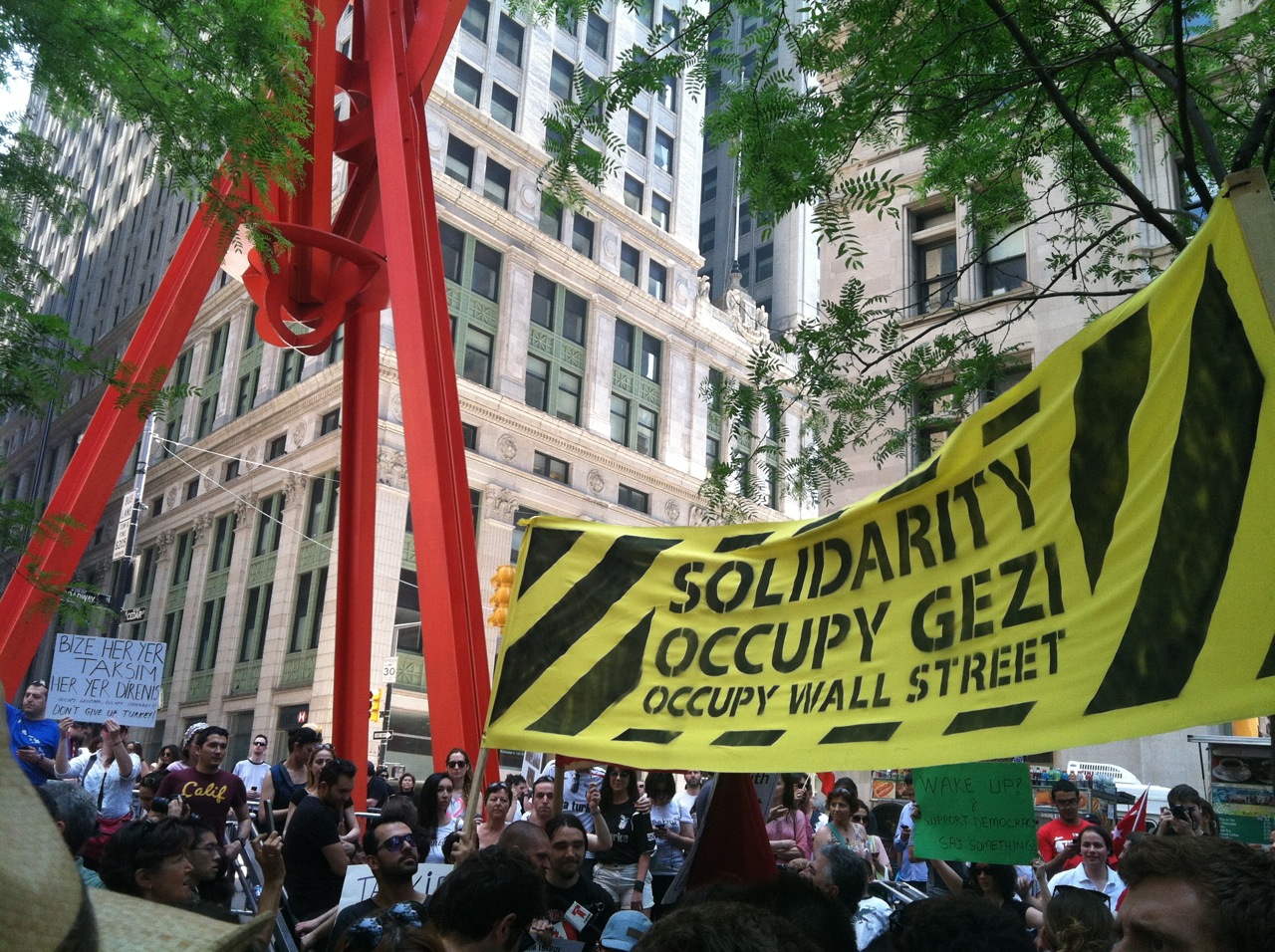
Last Saturday I attended the Occupy Homecoming in Liberty Square. I had heard ahead of time that there would be an “Occupy Gezi” solidarity rally happening in the park that day. I anticipated that the OWS presence might be light, aware that there was a Bradley Manning march at Fort Meade that same day, but I still thought the park would be filled with people. All of the solidarity rallies I have been to in the past have mobilized large numbers of folks from the local community. A common culture and a common language go a long way when trying to get people active, especially if their country has a history of popular protest. The familial dynamic, the ability to come together as sisters and brothers, that I have witnessed in many other cultures doesn’t comfortably fit into the core American identity. Declarations of United We Stand are common in times of hardship, and we have seen acts of tremendous empathy in response to natural disasters and other tragic events in recent years, but the core American identity continues to prioritize competition and self reliance over solidarity. In an earlier post I wrote about how the emphasis on independence and personal liberty has created a kind of “culture of doubt,” where people find it necessary to strike a defensive posture even when they are in agreement with others. Many of the conversations I had on Saturday dealt with this dynamic. Seeing the Turkish people come together so strongly had many asking why it was difficult to create similar dynamics here in the US among the 99%.

It got me thinking about the mythical guy (does this guy really exist?) who is outraged that he has to push 1 to continue in English. In fact, most of those phone systems no longer ask you to push a number at all, but you may be forced to pause momentarily to listen to someone ask Spanish speakers to push numero dos. Ok - stop for a moment - think about this. We live in a society that prides itself on being a “melting pot,” with a national motto of e pluribus unum (out of many - one), and yet we cannot seem to recognize this momentary pause as a simple courtesy extended to one of the many cultures that make up this rather amazing place. When I see the folks that speak Spanish as my sisters & brothers, this pause is not an inconvenience, but a teeny tiny little acknowledgement that they are just as welcome, valued, and essential in this country as I.

On Saturday the Turkish people in Liberty Square were chanting and singing mostly in Turkish. I took it upon myself to inquire from people I was standing near what some of the chants were, and what they meant in English. When a number of flags were raised and the crowd cheered I found out that the fans of rival teams that usually fight it out on the football field, had come together as Istanbul United to fight police brutality. It was amazing to me that everyone seemed familiar with each of the many songs that were sung. I found out that many of the songs were modeled after football chants/songs that were commonly known, that words were substituted using the same melody, and some were even sung verbatim. On the following day an effort was clearly made to do more chants in English and I availed myself of the opportunity to participate more fully.


Photo by Mickey Z.

I felt that the solidarity rally taking place in Liberty Square was both a tremendous acknowledgement of the significance of that space and of OWS, as well as a wonderful opportunity for us to connect with and learn about the people at the heart of another occupation. While the evidence of solidarity was clearly visible in the crowd that had gathered as well as in the SOLIDARITY - OCCUPY GEZI / OCCUPY WALL STREET banners that were present, the rally never seemed to me to coalesce fully. I don’t believe that it was about willingness to participate as much as it was a function of the ability to participate. As I mentioned above, solidarity is easier when you speak the same language. At one point a young man approached some folks I was talking with concerned that there was a right wing sign near one of the OWS banners. He thought there was the possibility that a photo of this could create the impression of an OWS endorsement of the message on this sign. He proposed moving all of the OWS banners away from the main group of Turkish people to avoid this. I asked him if he read Turkish - if he had read the sign in question. He replied that he had heard this information from someone else. The OWS banners, mostly held by the Turkish people themselves were not removed from the group, but I mention this is an example of how the language barrier can potentially limit our ability to connect. Mic check and move check were on my mind after writing about them in my last post, and I wondered why someone (including myself of course) didn’t mic check to welcome the Turkish people to Liberty Square, to express how powerful it was to be there in solidarity with them and the people in Turkey. I had hoped that participating in a mic check with the Turkish people might provide us a way to develop a deeper connection, to build empathy through internalizing the feelings that came up. Perhaps this happened earlier when I wasn’t in the park, or perhaps it happened between individuals, but even when we later bridged to the People’s Assembly, I felt that we were largely missing out on hearing and speaking (through mic check) the voices of the Turkish people present.

The People’s Assembly began with music, song, and an informative performance about Monsanto and GMOs by The People’s Puppets. Afterward a man got up and mic checked (paraphrasing here) that music and puppets were fine & entertaining, but that we needed to be more serious about the issues at hand. After he spoke another man mic checked that his family had been part of what he referred to as a “singing revolution” in Estonia. I believe that the inclusion of expressive performance at the beginning of the assembly was both an attempt to make the segue into the assembly go more smoothly, as well as an attempt to speak in language that was not simply based in words. There it is again - language. Translation. On a day that was filled with song and chants in Turkish, here we were encountering resistance to another language, a language based in artistic expression rather than linguistic precision. Do we all speak the same language? How can we express our solidarity even when we don’t? If we are in fact building a culture of resistance (as opposed to the fore mentioned “culture of doubt”), how can we be more mindful not to misdirect this resistance toward our sisters and brothers?


 Photo by Phoebe Berg
 
Tomorrow (Saturday), June 8th, there will be another Solidarity Rally in Liberty Square beginning at 12pm. March to Times Square scheduled for 4:30. Everyone is invited!

___

POST MARCH UPDATE - The rally and march on Saturday was well attended and well received. A powerful and beautiful showing of solidarity by all involved! Chanting “Resist Turkey - You are not alone!” “Resign Erdogon!” and “The people united will never be defeated!” we marched from Liberty Square to Union Square. At both Liberty and Union Square mic checks were done in Turkish and English so everyone could participate fully. Earlier on Sunday a Greek contingent joined the rally at Liberty, warmly greeted with loud cheers from the Turkish people. When people who have been made to distrust one another can come together, to recognize their common struggles and common aspirations: for freedom, for justice, for peace - the people united will never be defeated.

Check out these beautiful photos by Resa Sunshine of Saturday’s rally and march.

Friday, May 17, 2013

OCCUPY DANCE!

SPACE. When we occupy we are not really taking space as the word usually implies, we are instead making space: for dialogue, for ideas, for alternatives, for all voices to be heard. Space is where movement happens. And it is the movement that transforms the finite space of Zuccotti Park into the infinite space of Liberty Square (which is of course everywhere). Whether a park, a community center, a classroom, or the limitless expanse of the heart and mind; it is up to us to reclaim this common space, to recognize that we need not ask permission to reclaim what is already ours.

The raid on Zuccotti Park, the Cabaret Law, and online education - are these related? Well, let’s say one wanted to restrict the right of the people to peaceably assemble without appearing to do so, one could simply privatize all the spaces where people might choose to assemble. New York City enacted the Cabaret Law in 1926 to stem interracial dancing in Harlem Jazz Clubs. From 12,000 licensed dancing venues in the 1960’s down to less than 135 today. Perhaps it was not really dance that was being restricted, but movement. When people get together to explore their freedom, there can be unforeseen consequences. Along the same lines - it’s much more convenient to have students stay at home and learn through a virtual portal than to have them actually meet other students and potentially stray from the curriculum. Who knows what kind of trouble they might get into - who they might vote for or what state they might smash?! We must reclaim our common space in order to exercise our freedom, but also to invite others to do the same.

When I originally conceived of Occupy Dance I thought of it as political movement in a literal sense, as well as an occupation of the dance world by those who already considered themselves dancers. In a society where dancers perform and teach dance in order to make a living, how can we liberate dance so that it is accessible to all? How can we release it from commodity status, an art form only to be enjoyed as spectacle for the wealthy? But the single most important aspect of Occupy Dance was the idea that ANYONE can reclaim their own body - the space that is you. You don’t need to be qualified to dance, know the steps, have the moves, or be a “good dancer” to express yourself and explore your world.

The movement is you - Occupy Dance!


Photo by Andy “Fluffy” Beck

Connect with Occupy Dance on facebook or meetup

Please sign and share the petition to repeal NYC’s Cabaret Law

___

May 29 - Post Parade Update

MOVE CHECK! The human microphone (mic check) has been written up as a way to amplify voices, circumventing restrictions on the use of amplified sound at demonstrations, but there is another aspect of the practice that I have personally experienced time and time again. Participation in a mic check allows people to temporarily embody (in a very literal sense) the views of others. Key here is that one is not selectively choosing which voices to repeat, but simply repeating all that is said. There is something profound about feeling the idea resonate through your own breath, using your body to give voice to an idea that did not originate in your own mind. This simple act is akin to the kind of translation that dancers and other artists practice regularly; taking a concept, a thought, an idea and giving it a form that can be received by others. When Ilona Bito explained/demonstrated the concept/process of move check to me, I could immediately see how this dynamic was being expanded upon. As a dancer,* I have had the experience of watching others dance and feeling their movements in my own body. This is quite a bit different than simply watching them dance. It’s a kind of vicarious echo, drawing on experiential knowledge of what their movement would feel like were I to perform it myself. Of course, this mental exercise is also quite a bit different than doing the actual movement. As mic check repeats voice, move check is a repetition of movement. To begin - one calls out “move check,” which is repeated back in mic check fashion by those participating. We added a simple movement to this - a hop with arms straight up. This physical cue can be particularly helpful in focusing attention when one is in a larger group. The initiator then shares a movement with the other participants who then repeat the movement themselves. The practice is not intended to teach a particular step, but rather to share the feeling, the knowledge, and the sense of freedom that the movement embodies. As I mentioned earlier, dance can be an exploration of your world and move check offers an opportunity to share your discoveries.

After the Dance Parade I wrote a short note to the group about how the entire day felt like an extended move check to me (as Occupy often does), each of us sharing our movements with the group, each of us having the opportunity to experience the movements of all involved. When people get together to explore their freedom, there is always movement.


Photo by Jeremy Schaller

* I cannot count the number of times I have been asked “do you dance / are you a dancer?” It took many years before I stopped replying "not professionally" and simply started saying "YES!" 

Monday, April 15, 2013

PAYING FOR WAR

When I wrote Are we courageous enough to face the why? I was responding to how we categorize those who take actions we find unfathomable as “crazy,” their actions as “senseless.” In the wake of the Sandy Hook tragedy I have read, and responded to article after article that simplify the larger issue of violence in our society (and the world) to a singular conflict over “gun control.” Each side of the conflict seems quite content to call out the opposition as “extremist,” “out of touch,” etc. Despite the enormous amount of attention dedicated to the issue, I can count on one hand the number of times I have seen the weapons industry and gun manufacturers referenced in connection to the NRA and other gun advocacy groups. Instead the emphasis has been on the outrageous “polarizing” comments of individuals, and the “fringe” interests they represent. The rhetoric on both sides seems to have so many common terms it’s becoming progressively unclear to me just who owns this conflict narrative. There are, however, several things that do seem clear to me. Presenting the narrative as a conflict ultimately serves to reinforce the perception that gun owners are under attack, and strengthens any defensive argument the gun lobby makes. The righteous indignation that follows serves as validation of what I believe is essentially a coldly calculated business decision. Seen from this perspective the “extremism” is actually quite sensible: the more guns on the streets - the more violence we see - the greater our fear - the more weapons are sold. Any regulation of guns amounts to a restriction of gun sales, and less guns sold means less weapons industry profit. I am not implying that this business decision is an ethical one, but it is a rational one, and our insistence on categorizing it as extreme, crazy, senseless is only providing cover for an industry acting in its own best interest.


The other conflict dominating the news? Proposed Social Security and Medicare cuts to stem the deficit “crisis.” Similarly here, “extreme” positions mask the underlying dynamics. I do hear some talk about the deficit being a function of lost tax revenue due to massive cuts for the rich (and straight up tax evasion) coupled with high unemployment (of folks who would otherwise be paying taxes on their income). What I rarely hear is a critique of the wholesale looting of the treasury that has been pulled off by private “defense” contractors and... you guessed it... the weapons industry. Possibly a passing reference to the costly execution of two wars, the waste and mismanagement (“incompetence”), but never an actual indictment of war profiteers themselves. In Money Out of Politics, I brought up the specter of corporate leadership buying into office and then legislating for their own profit. Borrowing from the Social Security Trust Fund to pay for the Iraq War and then sounding the alarm on program insolvency should raise a little skepticism over the sincerity of those who are clearly looking to cash in on these programs through privatization. Like “gun control” the issue will be tethered to the big government/small government (no government) narrative, but again this is only to inspire outrage and provide cover. The actual objective is to funnel government money, and ultimately the resources of our people, into the coffers of a select few. Until we free ourselves from the illusion of separation between the corporate elite and “our” government leaders, the prevailing idea that politicians are merely influenced by lobbyists and not directly connected to the corporations themselves, we will continue to be trapped inside their scripted narrative. As I wrote in Visions of Peace, “As weapons dealer to the world and our own best customer, is it any wonder that American cultural promotion of war (violence, conflict, competition) is second to none?”

Tax day. How much are you paying for war?
___

Take Action - Global Day of Action on Military Spending
___

Related articles:
The Atlantic - Paying the Costs of Iraq, for Decades to Come
Reuters - Iraq war costs U.S. more than $2 trillion: study
Tom Engelhardt - The Enemy-Industrial Complex

Thursday, March 21, 2013

MISSING MARCH

March 22, 2003 - ten years ago tomorrow: denied a march permit for Feb 15, United for Peace & Justice organizes a march expecting 50,000 participants. Just days after the initial assault of Shock and Awe - 300,000 people flood the streets of New York to say No to War. “What do you want? When do you want it?”

Tomorrow I’m going to reclaim this power. I’m going to reflect on the feeling of freedom that came from standing in solidarity with millions around the globe. I am going to renew my vision of peace.

And I am going to march. Perhaps you will pick up a sign or a banner and join me?

On Facebook, Twitter, your blog - you can wrangle an entire banner with just one person! Feel free to swipe the sign and banner images below and share them widely. You can also find the images on Facebook. Use them to share your thoughts and your feelings. Take this opportunity to reclaim, reflect, and renew. “Peace - Now.”


Friday, February 22, 2013

INDUSTRY WHORE

“What do you do?”

“I’m a Graphic Designer.

For years, this was my response. I had been developing my own definition of graphic designer ever since I came across the term in a high school careers workbook. It wasn’t the same as artist, and it had a $25,000 salary attached to it. It was not simply about self-expression, but about communicating information, and it dealt with people called clients. In college my definition expanded exponentially to encompass every new artistic discipline I could get my hands on. Photography, illustration, typography, art history - all servants to design, all simple tools to realize my larger vision. Massimo Vignelli’s spoons told me that design could be anything and everything (or was it that everything could be designed?). So imagine my surprise, after a semester long project designing a style guide, when my most cherished professor asks me if I wouldn’t be better off in fine arts? Pick a company, design a logo, select typefaces, pick colors, etc. and define how all these variables will be applied to insure a consistent identity across a multitude of applications (referred to as branding nowadays). Anti-authoritarian rule breaker that I was, I didn’t pick a company - I picked Greenpeace. Visiting the Greenpeace Action office in New York, I could see the singularity of the Greenpeace identity, but I could also see power in the diversity of ways that the group represented itself. So I set out to create a modular, customizable, identity system - rather than restrict their identity to a single symbol. This didn’t go over too well at my critique, but more importantly, my selection of a social awareness organization seemed to call into question the very nature of graphic design itself. Many of my peers were enormously critical of my choice, believing that expression had no place within graphic design. That my chosen client clearly had a great deal to express apparently had no bearing on this. One of the first promotional pieces I designed for Forth Position was a mock style guide, subverting and redefining the objectives of the format.


Hitting the streets of New York after graduation, I charmed my way into meeting after meeting with the designers who had inspired me in college. When I had the opportunity to talk face to face with these talented men and women, I became increasingly aware of the gap between the vanguard design work I was familiar with and the day to day grind demanded by the industry. This didn’t come as a total surprise, but I had imagined that there were certain designers (certain studios) that had been able to free themselves from this duality, to somehow integrate their design production and do only good work. Along the way I had the distinct pleasure of working ever so briefly with the brilliant Marlene McCarty and Donald Moffett at Bureau, and of being offered a job at M&Co (which sadly dissolved due to lack of funds). Many of my top choices were struggling through the economic recession, so I felt quite lucky when Emily Oberman, then at M&Co, referred me to her close friend Bonnie Siegler, then Art Director at VH1 On-Air Graphics. Over the next four and a half years I gained first hand experience working with all the newly emerging tools of non-linear production and motion graphics, none of which were available while I was in college. My severance bought my first Mac (clone) and my apartment was transformed into a motion graphics studio quite literally overnight. Cable network identity and movie channel promotion was certainly not part of my original design brief for Forth Position, but the work was preferable to pimping for Nike and Coca-Cola. Having written a paper in college critical of the consolidation of media, I had no illusions that in the end I was ultimately working for the same interests. I was able to command a higher day rate freelancing motion graphics, and could therefore afford to work less often. This allowed me to devote more time to political organizing, and come 2000, I went all in.

“What do you do?”

“I’m a Peacemaker.

A stolen election, another Bush’s recession, and the war on terror - the next several years were a blur of political organizing for me. Protesting* to stop one war, protesting to prevent another, protesting the dictator himself. Hitting the streets again, this time for Peace & Justice, I was overwhelmed by the palpable feeling of freedom that came from standing in solidarity with millions around the globe. Marching with 300,000 in New York City was like being part of a river - it wasn’t about resistance, or conflict, it was about the inevitability of our momentum. The numbers were amazing, but did placing such emphasis on turnout diminish the power, the significance of other smaller rallies and marches? Why did it seem that the only way to be heard was to get thousands of people to show up? Did more people make the message more diverse, or just louder? Where did this emphasis on turnout come from? The media was insistent on the event having a singular message, a sound bite answer to the question of “what are they protesting?” There was no allowance made for multiple perspectives on the same issue, or for interrelated issues. The whole thing struck me as some kind of absurd competition orchestrated by the media and the interests they represent. The success or failure of the protest was to be measured in seconds of airtime, number of columns, size of the photograph… Time and time again we found ourselves in competition with the conveniently leaked government news event of the day. But the competition didn’t stop there. Awareness organizations, each with their own particular issue, were made to compete with each other to get their messages heard, to raise funds, even to find staff and volunteers to do the day to day work and necessary outreach. The status quo excels at provoking the conflict, escalating the argument, making the situation seem desperate - they don’t have to work so hard silencing us when they can get us shouting over the top of one another to be heard.


If I wasn’t on the street leading a chant, wrangling banners, organizing buses, getting signatures, I was likely in a meeting discussing how to go about it. Paying work was harder to come by, with the occasional larger job affording me the resources to pursue my own independent projects. Notobush was one such project, and while it was a success, it was not a money maker. I still hadn’t found a way to make prioritizing awareness, over profit, pay the bills. For the first time in my career I felt that I had a project that should be in the design annuals that had been such an inspiration to me as a young designer. So I entered the project into the AIGA 365 competition. Taking a line from the Forth Position Design Style Manual, and in the spirit of protest/demonstration that the work had derived from, I entered the entire project under the category “signage.”

The outcome of the 2004 (s)election had many within the movement switching back to strategies of damage control. Having to argue with the tax man over notobush related fees wasn’t punishment from on high, but it sure felt like it. Most of my paying work now no longer came from the networks themselves, many relying heavily on in-house designers or contracting out to a few larger studios.  Subcontracting through another studio meant less control over the specific jobs I worked on, and refusing a job due to ethical concerns wasn’t the best way to insure your spot on the short list for the next job. After the 2008 crash, many of the folks who had been keeping me busy were out pounding the pavement themselves. In the absence of any work to speak of, a producer friend of mine and I joked about pooling our resources and starting a lemonade stand. Television and the internet now offered a virtually limitless number of “channels,” an exponential expansion in real estate to split their resources among. The rise of reality TV ushered in a significantly lower threshold (and significantly lower budgets) for quality design. Marketing shows based on other successful shows had clients looking for “design” based on prior successful designs. While there were still plenty of designers doing beautiful work, I was seeing a glut of what I began to refer to as template design: 3d typography exploding from the center of the screen - light effects and lens flares at no extra cost! As I wrote in an earlier post, it can be challenging and frightening facing the prospect that the work you have spent most of your life doing may simply no longer be necessary, but these moments also bring the opportunity to reassess what it is that you truly want to do. In my early years as a designer, I thought of the concepts of design and innovation as inseparable. Within this new market driven repetitive design model, innovation was more often an unacceptable risk. I would go as far as to say that the model was actually pitting recognition of design that was tried and true directly against appreciation for anything new. Central here is the idea that the consumer (and the client) is more likely to buy that which they already recognize, so we should give them what they “want.” Of course in an industry where the very basis of desire is fabricated, who is to say what people really want?


So if I get paid to make shit smell great, to repackage the same old thing in the pre-approved newest freshest way - what am I? Am I really still a designer at all? Perhaps I was mistaken and this is what graphic design was always about? I purchased the domain industrywhore.com with the intention to explore this a bit. My original thought was to send out t-shirts emblazoned with an Industry Whore “logo” to everyone I know in the design industry, and perhaps a few others others I haven’t had the opportunity to meet personally. I started thinking about the responses I might get from my peers. Would they feel insulted by this? Would they feel liberated by someone finally stating the obvious? Would they struggle with whether or not to wear such a shirt? Would they wear it proudly, having accepted the role and the monetary reward that goes with it? Would my critique open up space for us to have a dialogue about such things or would it only provoke conflict? I’m still on the fence about all of this. When my two closest design comrades and I were in school we pledged to “burn the design world to the ground,” but I have no desire to hurt others who are doing their best to survive within a system they feel powerless to change. I must ask though - what if all of us, with our tremendous collective creativity, skill, and experience in communications, were to redirect our energies toward the change we wish to see? If this sounds too ambitious, maybe we have different ideas about the change we wish to see or have trouble imagining how we can make this change while still making a living, perhaps we could start smaller?

When I was starting out I wrote to a potential client deconstructing the pro bono process, pointing out that the firm designing their environmental campaign free of charge would likely turn around and use the work to promote themselves, ironically to score future work from the oil industry. I was attempting to position myself as an ally and a valuable resource, one that was not working simultaneously for and against the interests of my social awareness clients. Was this worth something to my clients? My friend Noah Scalin, founder of Another Limited Rebellion, writes:

It's extremely frustrating that many non-profits expect that design work should be done for free. They pay for rent, electricity, photocopies, etc. but when it comes to branding/marketing they assign no budget, and by extension no value, to it. Obviously the primary goal of an organization should be providing their products/services, whatever they may be, but if they are to have any impact at all they need to let people know that those products/services are available! It doesn't matter how great an organization they are, if no one hears about them or what they're up to, then no one will benefit from the work they're doing. And design is the primary tool by which an audience is reached with an organization's message.
When non-profits expect work done for free they're also expecting that the designers they are hiring should make a living doing something else. And there's the rub, since many times they end up working with larger ad agencies who make their profits from the very roots of the problems they're trying to resolve. And the agency's goals are generally to make award winning pieces that elevate their own status, rather than actually focusing on the success of the non-profit. If an organization truly wants to make the world a better place, they need to also consider all of the vendors that they choose to work with as well. By supporting designers that are also working for positive social change they are going to make a bigger aggregate difference.

As in my earlier example concerning turnout at a protest, I find myself asking where the emphasis on work for hire comes from? Perhaps it is intrinsic to graphic design? After all we are providing a service. But I think it is more than just this. Corporate design, advertising, design that makes money has long been prioritized within the field, even to the extent of dismissing other less profitable forms of design. Is work I am financially compensated for in competition with work I do for free? Is it possible to shift the imposed hierarchy beyond compensation, so that the values we embed in our work comprise the value of our work? What does this graphic design look like? How will it, and the designers who create it, be supported?

Lately I am finding it more challenging to answer the “what do you do?” question. I’m still in love with design, but the grand ideas and the precious details that once made it so alluring to me are easy to miss in our current culture of information overload. The systematic elimination of this preciousness by powerful interests seeking to own and propagate their singular (saleable) visions is disturbing to say the least, but my feelings are more complicated when it comes to the loss of preciousness as it relates to the rise of democracy. Throughout my organizing I have seen how important it is to allow space for dialogue, to make room for all voices to be heard. This process often requires letting go of the specific way I think something should be done, allowing the process to move forward to reveal unknown outcomes rather than predicting and controlling the result. I have spent much of my career looking for the next big idea, the quintessential project that will bring fame, fortune, and notoriety. And similarly questioning - which grand idea, which specific catalyst, will make all the difference and shift the paradigm in an instant? It occurred to me recently that this thought pattern is perhaps a product of connecting my artistry to my livelihood early on, and that giving it so much head space was blocking me from seeing other possibilities for myself. What would I do if money were no object? What would I do if the struggle was over? Can we set aside the superlatives and honor the intrinsic value of all living beings for just being alive? When I was little, people would ask “what do you want to be when you grow up?” Teachers would encourage me to “be somebody.” Of course, I already was somebody. And so are you.
___

Submit a post to continue the dialogue on the Industry Whore forum!
 ___

*I prefer the term demonstrating, but am using protesting for the sake of clarity: demonstrating an alternative path rather than simply protesting against injustice.
___

March 22, 2003 World Says No to War banner photo by Diane Greene Lent

Friday, January 11, 2013

VISIONS OF PEACE?

I want to try something new with this post. Lately I’ve been exploring how concepts like control, leadership, direction and sense of purpose, relate to empowerment and the creative impulse itself. With this in mind I’ve kept this post intentionally brief to open up space for your responses.

I’ve had this idea rattling around in my head for what I think might be a film, a film called simply - Peace. Throughout my involvement in the peace & justice movement I have met a number of organizers/activists who view the movement as one long ceaseless struggle. I have great respect for my sisters and brothers, for their passion and resolve, but I find myself wondering what happens after the struggle?

I have recently come across two strategies for realizing our creative potential. One focuses on removing obstacles that get in the way of being your true self, the creative spirit effortlessly emerging with the restriction removed. The other focuses on visualizing where you are headed, seeing yourself already there; obstacles fall away, replaced by this new focus of your attention. I like both of these approaches. I conceive of the Peace “film,” as a kind of visionary reference point, a common shared experience that might make it easier for us to recognize moments of peace wherever they exist (whenever they happen) in our lives and in our world.

As weapons dealer to the world and our own best customer, is it any wonder that American cultural promotion of war is second to none? Images of war (of violence and cruelty), those depicting the harsh reality of war and those meant to hide it from us, easily come to mind. But what of peace? Does peace appear more elusive simply because we haven’t taken the time, made the effort, to develop a peace vocabulary to speak of it?

Why a film? Primarily because of the grand scope of the medium; its ability to deliver powerful, meaningful, moving images; and its ease of replication and distribution. But also because, though films usually have a director, the scope of the medium generally requires a collaborative approach. That said, there is no set medium for this project. Indeed, an exploration of the very concept of medium might be one facet in the evolution of this idea...

Please accept my invitation to dialogue, to share your visions of peace with myself and other readers in the comments below. Feel free to approach this from any direction, any perspective, addressing any aspect of the idea that resonates with you. I am excited to hear your thoughts and I thank you for sharing them. 

Tuesday, January 1, 2013

THE END OF THE WORLD

So the world didn’t actually end, or did it? On the night that Hurricane Sandy hit New York I wrote a post titled “Are you listening?” concerning the way we deal with crisis after the fact rather than addressing the root causes ahead of time. We focus on preparing for the approaching crisis so that we can “weather the storm,” but we rarely take preventative measures to deal with the real challenge and its underlying causes. I don’t want to suggest there is a one size fits all response to this pattern, but I do think that we should pay closer attention to who profits from the crisis, from not taking steps to prevent it, and how our reactions may be manipulated to that end. Perhaps we need to break with the past and start addressing potential emergencies (not to be confused with the fabricated crisis after crisis coming out of our political process) from a perspective of providing for the common good rather than a function of defense. Maybe this “end of the world,” with multiple crises, real and fabricated on tap, is a good time to re-examine our priorities.

In the quiet days following Sandy, with our internet down but our power still intact (and much of the city shut down), we ventured to the video store (remember those?). On display at the counter was the movie The Day After Tomorrow. I remember when the film was released it was promoted as a fun way to raise awareness about global warming. I love a good doomsday flick, but now, with large areas of New York underwater, hundreds of homes destroyed, countless people without power, heat, food, clothing, shelter - it had lost its appeal. My partner and I were fortunate to live in an area relatively undamaged by the impact of the storm. Over this last year we have kept a computer near the bed when we sleep to periodically check in with the National Weather Service Radar. We have become more vigilant about such things since a tornado passed within half a block of our apartment. That same summer we spent my birthday camped out in an interior room, avoiding the windows during Hurricane Irene. Having lived in this neighborhood for nearly 20 years, this is something entirely new to me. During the summer there now seems to be a fairly regular pattern of storms passing through Brooklyn, building relatively quickly, some with tornado warnings in tow. There was no warning issued prior to the tornado I witnessed - someone got caught with their pants down... Two more tornadoes touched down in Brooklyn and Queens less than two months before Hurricane Sandy arrived in NYC. Seeing the devastation after Sandy left me with a distinct impression, we were lucky - this time.

Back before the millennium, while some folks were frantically stocking up on canned goods, I was tremendously optimistic about what might be coming in the new century. All of that changed for me when an unelected imbecile was installed in the White House following the 2000 election debacle, only gaining legitimacy through his forceful response to the 9/11 tragedy. When Hurricane Katrina devastated New Orleans I couldn’t help but think about how the Iraq war had come home. Surely with the media focused so intensely on the details of the disaster there would be no way to hide any opportunism that might take place in the aftermath of the storm - forced relocation, land grabs, real estate developments, a redistribution of voters, privatization of schools. Imbedded Iraq war journalists might not be expected to report exactly how Iraq’s abundant oil resources would be ultimately delivered into the hands of foreign corporate interests for “safe keeping,” but this was happening right here in the USA! I don’t believe it to be mere coincidence that the largest US petroleum producing region is off the coast of Louisiana, accounting for 80% of US deep water oil production. I read news articles at the time about national guard troops mobilized from outside Louisiana (and therefore responsible to federal rather than state authority) to “protect” land that was now vacant after the relocation of former residents. This kind of federal intervention in state affairs might seem warranted in lieu of the magnitude of the crisis, but again, I think it is important to consider who stands to benefit from the shift of control. If the land and resources are held in perpetuity, does the controlling party (occupying force) have the authority to lease the land, to harvest the resources? Should these decisions be made on a local community level, or by those with a controlling stake in the oil and gas industry? The argument is generally that these resources are too important (a matter of national interest) to be managed on a local level, that “experts” must be consulted in order to manage the resources correctly and efficiently. And who are these “experts”? They are professionals from the oil and gas industry of course, “experts” that will reap the profits from the decisions they make. The fox guarding the henhouse.

Within weeks of Sandy, Congress passed (and the President signed) legislation “authorizing the Secretary of the Interior to allow the construction and operation of natural gas pipeline facilities in the Gateway National Recreation Area and for other purposes.” Will the folks who live in the Rockaways, one of the areas hardest hit by Hurricane Sandy, have any recourse if this federal level deal turns out badly for them? If many of these former residents are not allowed to return or “choose” not to return (they are bought out or informed that their land is uninhabitable, etc.) after the storm, will it go unreported as in New Orleans? Is this an attempt to create a buffer zone around industry, to shield industry from regulation, to hide questionable conduct from the public? While we focus on the crisis at hand, is industry being allowed to convert our homes and our public assets into a means of production and delivery of their product? Strangely ironic that the rationale for this initiative is presented as a means to stem climate change through transition to “cleaner burning natural gas,” sponsored by the congressional representatives of people who lost their homes to the storm.

I recently attended a demonstration down the street from Mayor Bloomberg’s uptown residence - we were not allowed to be across the street as the entire block had been barricaded on both sides before we arrived. My partner and I held simple signs made on the spot that read SANDY IS NOT OVER and OCCUPYSANDY.COM FOR MORE INFO. The relationships that Occupy Wall Street engenders through its horizontal organizing model permits a back and forth between actual people that is much harder to achieve when dealing with larger hierarchical organizations. Assessing people’s immediate needs after the storm and finding creative ways to address them was a perfect match for Occupy. Time and time again I have heard people say the simple phrase “how can I help?” There is no need to be in control, no opportunism, no ulterior motive - just a genuine desire to help. I read an AP article that claimed, “The world heard the cry as that camp grew and inspired other ones around the globe. Ultimately, though, the movement collapsed under its leaderless format, and Occupy became largely forgotten. But core members, and a spirit, have persisted and found a new cause in Occupy Sandy.” I wrote the following comment:

Americans don’t want to believe that the Occupy movement was systematically repressed around the country and around the world. It is more comfortable to believe that a “leaderless format” must inevitably lead to the demise of OWS, but just because this narrative has been repeated over and over in the main stream media does not make it true. Similarly, just because the media hasn’t been there to cover the tremendous work of OWS over the last year doesn’t mean it did not happen. Rather than wasting words forecasting the demise or longevity of Occupy (we’ve heard that all before), why not write about how amazingly effective the Occupy model continues to be despite the systematic repression that occupiers have faced across the country and around the world over this past year? It is the way OWS deals with these and other challenges that makes it so special, not necessarily the specifics of the challenges themselves.

While researching for this post I came across a piece by Kevin Gosztola responding along the same lines to the false assessment in the AP article. What I think is really important to recognize here is that while it is clearly a good idea for us to address major challenges like climate change and its effects (as well as other emergencies) through some type of collective action, we must get beyond the default of relying on our military (and other hierarchical institutions) in these situations. It really should not be surprising when institutions focused largely on force and control turn out not to be the best suited to provide assistance and comfort. And we should not be surprised if, when these institutions are deployed, there turns out to be some motivation beyond the goodwill of the American people.

So what will it take for us to prioritize caring for one another over controlling one another? As we narrowly escape yet another “end of the world” and enter into this new year can we take a moment to visualize the path that we wish to take forward, setting aside the restrictions of what may or may not be possible? Can we see this as an opportunity for us to rethink our conditioned responses, to reset our reactions, to renew our resolve? Is this cultural obsession with catastrophic endings just a way for us to avoid the possibility that we may actually all have to live here together forever? It certainly makes it easier not to take responsibility for our actions, for how we treat one another, if the whole thing is going up in smoke anyway. There doesn’t seem to be any indication of catastrophe at the “end” of the Mayan calendar. We don’t expect the world to end every New Year’s Eve (well there was that one in 1999...). A cycle ends, another begins - it is up to us how we choose to take advantage of this new day. The more I hear the ceaseless din of crisis, the clearer it becomes that the first step through the noise may simply be to not join in the hysteria and outrage. If we can reroute this energy into seeking out a deeper camaraderie and compassion through interaction with our sisters and brothers, we will already be demonstrating a new vision of what is possible.

Peace in the New Year.
___


Forth Position designed sign for Febuary 17th climate change rally/march in DC.

Wednesday, December 19, 2012

Are we courageous enough to face the why?

It’s hard for me to approach this subject. I have no desire to capitalize on the current news cycle frenzy, but each time something of this magnitude happens I find myself thinking along very similar lines, and I feel I would be remiss if I did not call attention to the pattern that I see played out over and over and over...

Despite the continuous coverage dedicated to these events, the incessant repetitive replaying of every possible detail, the why of the tragedy never seems to come fully into focus. Those responsible are quickly categorized as “crazy,” their actions as “senseless,” any acknowledgement of their motivations is carefully sidestepped to avoid the appearance of endorsing their actions. Faced with such horror, people reflexively recoil; it is too frightening to think that there could be a reason for this behavior, that there might be a rationale to it, that it might be a predictable pattern. It is far easier to see it as the random terrible act of a disturbed individual, to see the act and the perpetrator as “evil.” But if we refuse to deal with the specifics of these tragedies in this way, how can we ever hope to address the multitude of factors that give rise to such tragic events?

We live in a society that is perpetually redefining our very concept of reality. Our leaders routinely tell half truths and often outright lie in order to score political points, their agendas validated by a media that willfully reinforces the chosen narratives. They initiate pre-emptive wars based on false intelligence, rationalizing the death of innocents through an ever escalating campaign of fear. While we watch our president shed tears for the Sandy Hook victims, his administration executes a predator drone kill list, resulting in numerous civilian casualties; men, women and children. We have been at war for the longest period in our country’s history, but less than 1% of our population is actively serving in our military. More soldiers are committing suicide than are being killed in action. The best selling video game of all time is a first-person shooter called Call of Duty: Black Ops, selling more than 25 million copies worldwide with more than half of those sold in the US alone.

We have “reality” television where the focus is almost invariably fame and fortune, certainly not the banal day to day details of our daily lives (there’s no ratings potential in that). Similarly, the “news” is so focused on sensational stories, that investigative reporting has become the exception rather than the rule. Important events often go unreported - as if they didn’t actually occur. Blockbuster films are increasingly dark and “gritty,” to infuse them with a sense of “realism.” Of late I have noted a reliance on depictions of pain and suffering to connect with the audience on a more visceral level, to convince them that what they are witnessing on the screen is more than fiction. These type of depictions no longer seem to have a genre (or story) specific character, and show up all over the map. Of course, the more common these depictions become, the less we respond to them, and the more intense they must be to elicit any response at all.

Inundated with images of violence and cruelty, our dominant narrative one of competition and conflict - are we losing our ability to envision alternatives? Politics, entertainment, & marketing have become indistinguishable, their influence on our lives so omnipresent that it is increasingly difficult to recognize their presence. The privatization of education is but another step in this process, another method for restricting our perception of “reality.” Many parents & teachers believe that they are preparing children for “the real world,” sparing them future suffering by forcing them to follow the rules. But the resulting stigmatization of difference, of resistance, of creativity can create a confusing impasse. We encourage them to be the best, to excel, to stand out from the crowd while we simultaneously demand they fit in. How are their young minds to make sense of this contradiction? Are we teaching them to create their own reality or simply accept the ones marketed to them?

Somehow, despite all the mixed messages, we expect people to be able to discern what is real and what is not, to recognize right from wrong, and to do it on their own. Ruling with absolute authority, whether as a politician or a parent, leaves precious little space for dialogue. In our punitive culture, where any deviation from the prescribed plan is met with ridicule, is it any wonder that people suffer in silence rather than seek counsel? Do people stay silent because they fear there will be consequences if they reveal their thoughts? Are we tolerant enough not to penalize those that step forward - tolerant enough to hear perceptions that may not match our own? Are we compassionate enough to deal with the sense of powerlessness that many in our society feel? Are we responsible enough to recognize our role in modeling violence as the solution of choice? Are we creative enough, and sensible enough, to come up with alternatives?

In the wake of the tragedy there are calls for gun control legislation, treatment for mental illness, greater security in our schools; but perhaps we need to move beyond these singular solutions. Are we courageous enough to face the why?
___


Related - NYT Business, 12/24: Real and Virtual Firearms Nurture a Marketing Link

Monday, December 3, 2012

VOTE EVERY DAY

As to be expected, there is a lot of post election speculation as to how and why the Obama campaign emerged victorious. While the variety of explanations are as numerous as the reports themselves, there is one uniformly consistent thread that was cited before and after the election - voter turnout. On one side of the proverbial aisle are those who forecast another close election with a razor thin margin of victory, on the other are those that point to pre-election polls that seem to have predicted the final results with surprising accuracy. The emphasis on voter turnout comes out of the close election scenario: when the electorate is evenly split, the deciding factor may well be how many people show up versus how many stay home. Voter turnout may seem like a given in terms of deciding an election (any election), but the overemphasis on it in this particular case feels artificial to me, as if it is being used to draw attention away from some other perspective. I recently wrote a post questioning the 50/50 electoral polarization myth that has become such a staple of our political discussions. Voter turnout can be a factor when one party has a clear majority, but even if the minority party turns out every last one of their voters, they may still be in the minority.

The appeal to fear of a changing electorate was overwhelmingly strident throughout this electoral cycle. Republicans’ brazen attacks on African American, Latino, LGBT, and Women’s rights inspired a surge at the polls that could not be stopped even through rampant voter suppression. But the extremity of these attacks simultaneously allowed Democrats to adopt a protective stance, rather than one advocating to expand the rights in question. The fear cuts both ways it seems, insuring that those less enthusiastic about Obama’s record don’t take the risk of voting for someone more in line with their concerns. The Obama Administration is happy to accept your support whether or not you agree with their agenda - just keep it to yourself. But perhaps the changing electorate is more than the Democrats bargained for. What if those so passionately mobilized to vote by the attacks on their rights refuse to back down? What if they move beyond this protective stance to mobilize for the expansion of those rights? What if they shift en masse from a strategy of simply making demands on those in power to one of development and mobilization of their own alternatives, and start using those alternatives to withdraw their consent from the status quo? What if they are no longer satisfied with voting every four (two, four, six) years? What if they choose instead to vote every day?

A freshly re-elected president brought to tears in a moment of connection with the young volunteers so integral to his campaign; it was certainly not something I had seen before, and I found myself surprisingly moved by the spectacle. It appeared intimate, and personal, and the president’s words were remarkably humble. After I watched it I thought about how this address might be different from others that the president has made. Watching him enter and exit the scene I wondered if there would be any opportunity for these “smarter,” “better organized” and “more effective” volunteers to share their hopes and dreams for the country, to participate in an actual dialogue with their president? A little more than a week later I read a short article titled, “Obama campaign asks: What do we do next?” The link in the article delivered me to an Obama for America survey. Was this the medium for dialogue? Perhaps this document could be a starting point for the volunteers to input their ideas beyond the election cycle? As I read through the three pages it was apparent that the reference point for the questions was mostly limited to the campaign and future campaigns. There were a few questions that allowed for short “write in” answers and several at the end requested a sentence or two, but by and large the questions focused more on “how can we campaign better” than “What do we do next?”

One survey question asked “What issues would you be interested in volunteering or organizing around in the future?” Among the 24 options there was only one issue that expressed a specific viewpoint in the way that it was stated: “Avoiding the fiscal cliff.” When the Bush tax cuts were originally supposed to sunset in 2010, the Republicans played their tried and true “tax and spend liberal” card to flip the switch and claim that allowing the tax cuts to expire was in fact Obama raising taxes. A clear majority of the country was not in favor of extending the tax cuts for the wealthy, but Bush & Co. were crafty enough to design the tax cuts as a reduction of rates across the board. The tax cuts for the lower tax brackets were a pittance next to the windfall for the 1%, but tethering the two together allowed Republicans to push the idea that Obama would be “raising taxes” on everyone. The ball was already rolling on the so called “fiscal cliff” prior to the election, setting it up as a showdown, an impending crisis just beyond the horizon. Once again the Republicans are playing that same card, attempting to run the table. My understanding is that even after we go over the “cliff” Congress could pass legislation retroactive to January 1 (extending the cuts for the “middle class”), but the narrative would be significantly different. With the cuts officially expired, the Republicans would have to defend higher taxes on the “middle class.” Sounds like a pretty good move strategically, so why then is Obama for America promoting the “fiscal cliff” narrative?

I’m hearing a lot of talk about the Obama ground game and the effective use of collected information - this tremendous marketing campaign seems to have paid off, but what have we learned? Are we being sold a president the same way we are sold a pair of sneakers or a box of cereal? Are we being invited to participate in our democracy when we answer the polls and surveys? Is this collected information useful in addressing the challenges we face or is it just a mechanism for securing our vote, and through that vote our deference to authority? I read an article that mentioned grassroots movements in conjunction with supporting the administration’s agenda, but this top down approach (the agenda being set by the president) seems contrary to the very nature of grassroots organizing. In yet another post election piece I read this:

Following re-election, the president wasted no time taking advantage of the organization's massive base. Obama spoke to 30,000 supporters on a conference call last Tuesday about the fiscal cliff, rallying the troops as he began negotiations with congressional leaders to find a deficit-reduction package.

"Our work can't stop now," he said, according to audio of the call. "We're going to need you guys to stay active. We need you to stick with us and stay on this and I'm pledging to do a better job even than we did in the first term in making sure you guys stay involved, that you guys know exactly what we're doing, that we're giving you guys clear directions and talking points in terms of how we keep mobilizing across the country."

We don’t need a marketing campaign to keep us engaged, keep us busy, keep us quiet. Can the OFA network, or perhaps another network altogether, be used instead to ask our people how they think we should address the challenges we face? Perhaps as a means to submit proposals, compile ideas, develop solutions to these challenges? Elevation of ideas from the bottom up is what grassroots is all about - the community participates, not as de facto liberal lobbyists and cheerleaders, but in the actual process of policy development and decision making. When it comes to the “fiscal cliff” Obama is asking us to make Republicans concede to his demands, not to make him concede to ours. With few specifics being offered we are expected to support an agenda that we have had no part in creating. I can recall talking to Bush supporters in 2004 about their “$300 tax rebate” when they brought it up as a reason to re-(s)elect Bush, and asking them if their city and state taxes went up to balance the loss of federal revenue. Isn’t bush getting your vote for nothing if the same amount of income is extracted from you one way or the other? How do you feel about getting duped like that? Will our states and cities be made to compensate for Obama’s proposed federal spending cuts? What and how much will we be asked to sacrifice in order to keep “our” tax cut and make the 1% pay their “fair share”? When you get to the end of the survey there’s a button labeled “submit.”

Is this entire campaign an empty distraction? Mobilizing Americans, not to stop federal fracking legislation, not to repeal NDAA indefinite detention, not to press for climate change ACTION in the wake of Hurricane Sandy, but to tell stories to their congressional representative about what they could do with that 2,000 bucks (for a “typical” middle class family of four). I've written before about how electoral politics is used to distract us from pursuing any kind of direct democratic action: as a siphon of limited time and organizing energy, but also as a restraint to keep us in line. Is this new perpetual Obama campaign just another method of instilling a false sense of purpose in the volunteers? On Black Friday I saw a report on the news where a young man interviewed outside the local Walmart talked about the sense of camaraderie he found waiting in line - it was like they all had a common cause...

I recently worked on a video for a David Weinberger talk titled “The Networking of Knowledge and Storytelling.” The producer on the project and I had a discussion at our initial meeting about the formation and evolution of ideas, sketching tiny diagrams to represent the flow of information. Person A says “Apple,” person B says “Orange.” Weinberger presented a model of networked knowledge stemming from linked ideas, ideas often in contention. “We know now in networks, not as individuals.” It reminded me of concepts that I was becoming familiar with through involvement with Occupy Wall Street. I had been learning about consensus and was beginning to understand how an idea that was evolved through a small group, a working group or an affinity group, might avoid the defensive trappings of ideas proposed by individuals. An individual might spark the process in the group, but it seemed to me that most ideas had a kind of life of their own that preceded their initial proposal. It struck me that this process was a method to free “our” ideas from ownership, to let them exist independent of individual ego and belief, to invite and encourage modification of the ideas through alternative perspectives. Of course, the form of horizontal direct democracy that OWS is evolving is quite different than what we see practiced in our government.

When the president tells us that his first job is “to keep the American people safe,” he is fortifying his patriarchal role, inviting us to breathe a collective sigh of relief that we have someone in the White House watching out for us. Certainly there is comfort in trusting that our leaders know what to do and how to do it, but how does the president’s role as decider - protector - leader fit into the community organizing model that he seems to favor? There is comfort in having direction and feeling a sense of purpose, but folks need never define these things for themselves if they are consistently provided for them. Is it ultimately more empowering to take control and lead the way, or to allow people the freedom to choose their own path? And what do we lose when we supplant the collective potential of many people with the perspective of a single individual? The representative democracy practiced in the US need not inhibit community empowerment so long as representatives are selected by the community to represent the ideas of the community, but where there is forceful repression of alternative forms of democracy, there will likely be “leaders” who are no longer representative.

When Obama says “we’re all in this together,” does this togetherness involve us organizing/mobilizing with and for each other or only in support of the president’s agenda? The close election scenario, the polarized electorate, the “fiscal cliff,” whatever it is called - it is a contest, a conflict, a crisis marketed to the masses. Another distraction in a long series of ever more urgent events, signaling our minds to shut down our creative potential and focus on securing our survival. There may be actual consequences if action is not taken immediately (what kind of crisis would it be without dire consequences after all?), but this does not change the fact that it is a fabrication, an abstraction that we have created and that we consent to. We should not limit ourselves solely to the options that are placed before us, Democrat or Republican, taxes and/or spending cuts, jobs or environment, unions or budget shortfalls, energy independence or climate change action... This process is self perpetuating in that the original challenge is replaced by a conflict, requiring us to make a “choice” rather than seek a creative solution (or multiple solutions). Is it even possible within the present construct for the President to ask us for ideas and assistance without compromising his status as a “leader”? Whatever the answer, we must recognize that the limits of the presidency, the Congress, the government do not need to be our limits as well. Thank you for voting. Thank you for exercising your power. It’s yours - you can do it every day.