Showing posts with label Looting. Show all posts

Wednesday, February 15, 2017

POTUS: PRIVATIZER OF THE UNITED STATES three steps to undermining the trump agenda

You know things are bad when people are willing to get their medicine from the snake oil salesman. Huckster, hustler, button pusher, scammer, scoundrel, swindler. Whatever you want to call this guy, there is one single word that should be inextricably linked to his name and his brand of snake oil:

Privatization.

Say it with me now: pri-vat-iz-a-tion (prī-və-tə-ˈzā-shən). Get used to saying it. Every time he tweets – #privatization. Every time he has a rally – privatization. Every time he signs another baby’s first executive order – privatization.


The basic is this: neoliberals were chomping at the bit to privatize every government program they could get their greedy hands on long before this guy entered the race. And in classic Newspeak fashion they’ve provided an out of control anti-establishment champion for everyone to hate as cover for the installation of an entirely corporate cabinet. Doubleplusungood.


Let’s be clear here, this is no longer simply the fox guarding the henhouse. This is not about lobbyists writing legislation, or corporate kickbacks, or pay for play – this is about putting corporate executives directly in control of our government.

Sure, they’ll continue to tow the party line: smaller government, lower taxes, reduce the deficit, government corruption and reform (“drain the swamp”), but keep your eye on the ball. Will this administration really use their power to do away with all of those “bloated bureaucratic agencies” or will they simply use the existing infrastructure to reroute all those tax payer dollars into their own pockets?

So why are so many willing to accept this clear conflict of interest?

Well, you see, we’ve got this thing in the States, a straight up hard on for guys in suits that can put one over on everyone around them, take advantage of every poor sucker along the way. We put these folks on the cover of Fortune and Forbes and call them “the smartest guys in the room.”

This guy may not look like them, you may not even think he’s smart enough to be them, but that’s the genius of it. This snake oil salesman is selling the appearance of wealth. He’s been pushing his get rich quick schemes on late night TV for decades. His string of bankruptcies might give the impression that he’s been a failure at this game, but nobody called Jamie Dimon a failure when we bailed his ass out.

Everyone else in the world – yeah, pretty much everyone, calls this thing they are doing “austerity.” In a nutshell – those in power engineer a crisis, financial or otherwise, and then blame some other folks in power for doing an inadequate job handling the crisis.

Here’s where it gets fun – they’ll claim that the crisis, and the inadequate response, is proof of a systemic failure and call for reform. This reform is always the privitization of the existing system. This privatization involves tax payer money being allocated to them and their private companies in place of the public institutions that normally handle the job. They claim that privatization will be more efficient and yield a greater return on taxpayer investment.

Sounds like a pretty good deal, right? Problem is, once they get that fat government check, they’re free to welsh on the job or do it in such a substandard manner as to escalate the crisis, leading to further privatization...

Of course, blowing all this tax payer money on nothing means that every time the people want something for their taxes, the powers that be can claim that there just isn’t enough to go around, salaries are too high, benefits must be cut, we all have to make sacrifices. All smiles across the aisle.

There is one more essential step in the neoliberal crisis capitalism playbook – they’re going to offer you, your city, your country, a loan. A loan to make up for all that revenue they just swindled you out of, all those resources they gobbled up, and all that public land they privatized. And with a smile and a handshake they’ll snap on the shackles of debt, turning you into a product they can buy and sell on the market. That’s austerity, and it’s right here in the good ole US of A, even if we’re all too cranked up on conflict narrative culture to see it.

So if the snake oil salesman is respected by the people specifically for his ability to get over on the people, how does one mobilize the people in their own best interest? Well, if exposing his duplicity only serves to further validate his prowess, then perhaps a less direct, less confrontational approach is needed. The anti-globalization movement’s “¡Ya basta!” and a phrase I often heard repeated at OWS, “I would prefer not to,” come to mind. I recall messaging discussions concerning the framing of 2003 The World Says No To War demonstrations as a rejection of business as usual, a principled stand, a withdrawal of consent.


With this in mind I’d like to propose a basic three step outline for undermining the strategy of domination through privatization. I am hoping that it provides a simple starting point for other organizers and media folks to build upon, a focus beyond the fractured reactionary response being scripted for us.

1 ) Take a closer look at the government agencies under threat of privatization. Start with the cabinet level offices and work out from there. What do these agencies actually do? Who are the appointees that will lead these agencies in this administration? How will their positions benefit them and their corporate interests? How will the agency infrastructure be used to redirect tax payer money?

2 ) Given that these agencies may now be used to oppress rather than to protect, what alternatives can we come up with in light of this privatization? This is a tricky thing to propose, because the administration would like nothing better than for us to cede complete authority to them in all these areas. But if they have taken control of the government, we really need to start coming up with alternatives that are insulated from their influence.

3 ) Make these alternatives viable, accessible, and desirable. This may involve the redirection of public funds toward alternatives to privatized government programs, a mass mobilization involving divestment and reinvestment focused on a withdrawal of consent. Not just boycotts and strikes, but the work of building viable alternatives to replace the existing dependencies.

Move Your Money is an example of one such alternative mobilization. The campaign was pretty successful, with individuals, unions, and whole municipalities moving their money from predatory big banks and financial institutions into local credit unions and community banks. Just recently, the Seattle City Council voted to divest $3 billion from Wells Fargo over the bank’s backing of the Dakota Access pipeline.

Most notably, the campaign wasn’t presented simply as an ethical imperative, but as a practical benefit. Moving one’s money from a bank that charges outrageous fees with no interest to one that offers free checking with interest is obviously attractive. The key then is accessibility. Is there a local credit union office in the neighborhood? Is one’s money accessible through ATM’s in the neighborhood? Could that vacant building next to the check cashing place be secured to house a new credit union office, providing an obvious visible alternative at the point of interaction? These are the kinds of details that must be addressed to encourage people to withdraw their consent, while simultaneously helping themselves.

There is enormous opportunity to mobilize the people through a desire for what they want, rather than simply controlling them through fear and desperation. This is, at its core, about replacing a narrative of scarcity and strife, with one of agency and empowerment. If this (s)election told us anything, it is that the people would rather vote for something than for nothing at all. The snake oil salesman only has power if we keep buying what he is selling. And privatization really is about selling you what was yours to begin with. Withdraw your consent and take it back.
___

Related articles:
Is Your Bank Funding DAPL? Here’s How to Find One That Isn’t – Gerald Mitchell
Trump’s Crony Cabinet May Look Strong, but They Are Scared – Naomi Klein
Donald Trump’s Executive Order Will Let Private Equity Funds Drain Your 401(k) – David Dayen

Here's How We Prepare to Be Ungovernable in 2017 – Sarah Lazare 
Intercepted Podcast: The Clock Strikes 13, and Donald Trump Is President – The Intercept

Thursday, December 4, 2014

POLICE SELFIES

On Monday President Barack Obama called for $75 million to equip 50,000 protestors across the nation with body cameras intended to track their interactions with police officers. Using the multiple simultaneous camera angle sources, as well as other high tech gadgetry and training that the three-year $263 million spending package will provide for, protestors will now be able to recreate any recorded event in virtual three dimensional space, similar to the popular Google Map “Street View” feature.

No – not really. The cops get the cameras.

Obama is proposing a three-year, $263 million spending package to increase use of body-worn cameras, expand training for law enforcement and add more resources for police department reform. The package includes $75 million to help pay for 50,000 of the small, lapel-mounted cameras to record police on the job, with state and local governments paying half the cost. AP Article

How bizarre it seems to “record police on the job” by having them wear cameras that will only show what they are facing and not themselves. I suppose if you are at a protest that is surrounded by police then individual officers could inadvertently film each other in action, but if the interaction is between a single police officer and an individual, it is highly unlikely that the officer will get any face time.

I became aware of this proposal reading an article titled “President Obama Is Doing the One Thing That Will Prevent More Fergusons.” What constitutes “more Fergusons” here? Will this “one thing” prevent more shootings of black youths? Will this “one thing” prevent more protests in response to the shooting of black youths? Will this “one thing” prevent more stories of injustice from being heard? The headline does not consider any other option that might put the decision making power into the hands of the people rather than the police (and those that control them). Recording the interaction between a police officer and an individual does nothing to change the existing power dynamic, it is still ultimately up to the officer to decide whether or not to use force. And as we have seen over and over, recording (documenting) abuse of power, while important in and of itself, does not necessarily ensure accountability.

The issue here is not the cameras themselves, as I point to in my opening, it is access and control (as well as the allocation of public resources). Who will have access to the footage that will be collected by officers wearing body cameras? Who will decide how the recordings can and will be used? Who decides where the officers are deployed and what gets recorded? Will this policy amount to yet another fishing expedition in communities that are already profiled by the police? Along similar lines, should your attendance at a political demonstration be taken as your consent to be recorded by the police? In New York City there was something called the Handschu agreement set up to regulate police behavior with regard to political activity. Beyond taking legal action after the police have chosen to disregard the specifics of such agreements, what recourse is there? Who will police the police?

I attended an event last week that involved several artists performing work inspired by George Orwell’s Nineteen Eighty-Four and Aldous Huxley’s Brave New World. Afterward the audience participated in a discussion with the artists. Surveillance was a major topic of discussion. The use of body cameras by police was brought up by someone who spoke of the importance of the act of witnessing in connection with justice. One audience member responded to this by declaring that surveillance was not intrinsically good or bad as long as we were aware of it. This reminded me of the common refrain if you haven’t done anything wrong then you have nothing to worry about. I wrote a recent post about how people seldom realize what freedoms they actually have and do not have until they attempt to exercise them. I said something to the group about how the information that is collected may seem inconsequential until you decide to run for public office and quickly find yourself discredited through a false narrative based around some small bit of that collected data. Many simply responded by laughingly exclaiming that they would not be running for President anytime soon. But there is more to it than this. Individuals & activist groups are commonly discredited through this process, their potential effectiveness neutralized. Entire segments of the population are demonized through smear campaigns anchored on some small piece of “evidence” taken out of context or even outright staged so as to validate the narrative. We see this same type of logic playing out in the courts as well, where victims of crimes are discredited in order to derail prosecution of the assailant.

I have seen a number of folks questioning the meaning and the use of the terms “looting” and “riot,” perhaps looking to redefine the narrative. I’ve referenced the term “looter” in earlier posts – from my post DAYANIŞMA / SOLIDARITY

Diren Gezi is Gezi Resistance. Taksim (Taksim Gezi Parkı) is the park that is being occupied in Istanbul, Turkey. Not to be confused with Tayyip (Recep Tayyip Erdoğan), who is the Turkish Prime Minister. Tayyip Istifa! is a chant for him to resign. Çapuling is chapulling. If you are unfamiliar with the word chapulling, that is because it is a new word. Tayyip (remember him?) has taken to calling the demonstrators ayyaş (alcoholics) and çapulcu (looters). Rather than defend against this, the demonstrators chose instead to reappropriate the term çapulcu. The urban dictionary defines the term as “to resist force, demand justice, seek one’s rights.” The term “looters” shouldn’t be unfamiliar to us here in the US. We have heard it and other similar terminology used time and again to dismiss the legitimate concerns of people in need and those that rise up against social and economic injustice. In the aftermath of Hurricane Katrina the US news media was rife with stories casting desperate victims of Katrina as marauding bands of “looters.”

And from MAN UP

In my previous post I noted how the term “looters” and other similar terms have been used time and again to dismiss the legitimate concerns of people in need, to vilify those that rise up against social and economic injustice. Those who struggle against oppression must be cast as a malevolent force in order to make a defensive response seem reasonable. If they can be successfully cast as a threat, then their oppression appears warranted - the narrative presents this action not as a choice but as a necessary defensive response. When faced with the dualistic framework of fight or flight, there really is only one acceptable option encoded into our (USA) culture - to stand your ground. The mass incarceration of young black males fits into the “self-defense” narrative as a strategy to keep blacks off the streets and off the voter rolls. But it is an offensive strategy as well, generating enormous profit through prison development and maintenance, while supplying cheap labor (less than a dollar an hour) to participating corporations. Are these young men being sold into slavery?

While watching a livestream of the protests in Ferguson the night the grand jury decision was announced I could clearly hear a voice repeatedly announcing that if you were in the street it was unlawful assembly and you would be subject to arrest. Then the voice would simply say loudly “Do it NOW!” Is this a matter of legal rights or solely a matter of compliance? Let me be specific here – are these people in the street (if they are actually in the street) doing something illegal? Or are they being threatened with arrest solely because they refuse to obey an order that has no legal basis? It got me thinking about how the law can be used as a validation of injustice. An example: when the Chicago Teachers Union went on strike Chicago Mayor Rahm Emanuel cited a law that he claimed the teachers were in violation of. Doing a bit of research I discovered that this law was passed the previous year, likely for the express purpose of preemptively criminalizing the action so as to cast the teachers in a negative light. This kind of legislative suppression of democracy has been happening all over the country with ever increasing frequency. This isn’t a new idea of course, the laws governing free speech and assembly have been effectively rewritten through all sorts of local, state and federal legislation. From the Patriot Act and NDAA, to H.R. 347 – the “Criminalizing Protest” law. Local restrictions abound on exactly where and how many people can assemble through permit processes that clearly conflict with First Amendment protections. The wholesale privatization of public space further blurs the line between assembly and trespass, casting those who are simply exercising their rights as “law breakers.” As with surveillance, the issue here is not necessarily what you have done wrong, rather it is that anything you do can be made wrong for the purpose of your control. 

An individual who breaks a law that conscience tells him is unjust, and who willingly accepts the penalty of imprisonment in order to arouse the conscience of the community over its injustice, is in reality expressing the highest respect for the law.
– Martin Luther King, Jr.

But what if the law has been written specifically to remove any opposition to the injustice, if your imprisonment (or indefinite detention) is the actual objective? When those in power have free reign to ram through laws criminalizing any action they deem threatening to their authority – do we still call it democracy?

As I am writing this I read that a New York grand jury has cleared NYPD officer Daniel Panteleo in the death of Eric Garner, this despite the officer’s use of a chokehold prohibited by NYPD policy, seen in a video recording of Garner’s death captured by bystanders.
___

Excellent report on Democracy Now concerning Ferguson and the proposed $263 million spending package.

The Police in America Are Becoming Illegitimate by Matt Taibbi

Seen It All Before: 10 Predictions About Police Body Cameras by Robinson Meyer

Saturday, August 10, 2013

MAN UP


“And for those who resist that idea that we should think about something like these ‘stand your ground’ laws, I just ask people to consider if Trayvon Martin was of age and armed, could he have stood his ground on that sidewalk? And do we actually think that he would have been justified in shooting Mr. Zimmerman, who had followed him in a car, because he felt threatened? And if the answer to that question is at least ambiguous, it seems to me that we might want to examine those kinds of laws.” 
Barrack Obama - President of the United States

“The attorney general fails to understand that self-defense is not a concept, it’s a fundamental human right. To send a message that legitimate self-defense is to blame is unconscionable, and demonstrates once again that this administration will exploit tragedies to push their political agenda.”
Chris Cox - Executive Director of the NRA-ILA


While it is unlikely that the Obama quote is intended as an endorsement of Trayvon Martin’s right to stand his ground, it does call into question the hypocrisy of the implementation of the law. But does the statement, perhaps unintentionally, play into the narrative that Trayon Martin was, and black men (teens, boys) in general are, a potential threat? Whether self-defense is a “concept” or a “right” or some other thing yet undefined by the narrative, the basis for Stand Your Ground laws is FEAR. Fear that one is under threat becomes the motivating factor for using deadly force and more importantly the deciding factor in determining whether that deadly force was warranted. Who is controlling this fear narrative and what is there to gain from it? I have seen the Obama and NRA statements presented in the media as two sides of an argument, but they seem strangely congruent to me in that they both focus on self-defense, rather than on violence or justice. Imagine for a moment how the case might be different if Trayvon Martin were 5 years of age when he was shot and killed rather than 17. Would the Obama statement still make sense if the boy who was shot was clearly incapable of defending himself from a violent assault - incapable of standing his ground? Does the burden of guilt shift here? And to whom does it shift? Are our laws written to protect this boy’s life or to protect the one who takes that life?

The circular logic of this “self-defense” (fear) narrative sees individuals as monsters, violent by nature, incapable of reason, justifying a violent (“defensive”) response. Through this logic, even if Trayvon Martin felt threatened by Zimmerman and acted in self-defense (which would have to be be proven, not simply assumed to be true), Zimmerman’s violent response would still be warranted. It is through this logic that a trial to determine Zimmerman’s guilt or innocence in the shooting of Trayvon Martin is transformed into a case determining the guilt or innocence of the boy who was shot dead. Has Stand Your Ground circumvented presumption of innocence in this case, effectively making Zimmerman judge, jury and executioner? What crime has Trayvon Martin committed here? Unlike other interpretations of self-defense law where an individual must be in imminent danger, it would seem that the Stand Your Ground law in Florida may accept a provoked assault (the person claiming to have acted in “self-defense” has actively provoked the confrontation) as justification for the use of deadly force.

Three things come to mind:

One) The gun industry stands to profit regardless of how this scripted narrative plays out, whether young black men are cast as the threat or they are made to feel that they are under threat. As I pointed out in an earlier post - presenting the narrative as a conflict (cynically capitalizing on existing racial tensions) ultimately serves to reinforce the perception that gun owners are under attack, and strengthens any defensive argument the gun lobby makes. The righteous indignation that follows serves as validation of what I believe is essentially a coldly calculated business decision. Escalating violence and fear insures repeat customers, and the weapons industry is happy to sell to both sides of the conflict. This isn’t about “gun control,” it’s about violence. This isn’t about “self-defense,” it’s about justice.

Two) The NRA did NOT (through intensive lobbying and campaign contributions) create Stand Your Ground to fill some sort of self-defense law void as one might be led to believe. Self-defense law has been common throughout the United States for more than a century. The main difference in these new laws is an expansion of the justified use of deadly force outside of one’s home (the so called Castle Doctrine) to any place that one is legally allowed to be, removing the duty to retreat and codifying civil immunity for the person using this force. In other words, the shooter cannot be sued for damages in a civil lawsuit so long as they are not found guilty of homicide. It remains to be seen if this new legislation will provide civil immunity in cases where victims’ families pursue legal action seeking damages from the gun manufacturers themselves, similar to cases brought against the tobacco industry in the past.

Three) The common presentation of Castle Doctrine as defense of one’s home (someone breaking into your home is clearly up to no good!) seems misleading to me. This perspective seems to shift the purpose of the law from defending one’s life to defending one’s property. Will “self-defense” under Stand Your Ground ultimately be applied to property in the way that personhood rights have been applied to corporations? What does the Libertarian defense of the right to bear arms look like in this context? Are they fighting for liberty or to secure immunity for those who would steal it from them? As more and more of our public spaces and resources become privatized, we should be vigilant not to allow the “protection of property” to trump our civil rights.

In my previous post I noted how the term “looters” and other similar terms have been used time and again to dismiss the legitimate concerns of people in need, to vilify those that rise up against social and economic injustice. Those who struggle against oppression must be cast as a malevolent force in order to make a defensive response seem reasonable. If they can be successfully cast as a threat, then their oppression appears warranted - the narrative presents this action not as a choice but as a necessary defensive response. When faced with the dualistic framework of fight or flight, there really is only one acceptable option encoded into our (USA) culture - to stand your ground. The mass incarceration of young black males fits into the “self-defense” narrative as a strategy to keep blacks off the streets and off the voter rolls. But it is an offensive strategy as well, generating enormous profit through prison development and maintenance, while supplying cheap labor (less than a dollar an hour) to participating corporations. Are these young men being sold into slavery?
 
Occupy Wall Street was relentlessly attacked in the media on two fronts, cast as a dangerous threat while being simultaneously marginalized as a bunch of do-gooder trust fund kids with nothing better to do than camp out complaining about their first world problems. The first strategy clearly relates to what I stated prior having been widely used as justification for the forced eviction of Occupy camps, but the second strategy is related as well. One of the central tenets of an OWS occupation is that everyone is welcome to speak, and all voices are honored, no matter what their viewpoint is. This is in stark contrast to a status quo that reinforces conformity by punishing us if we stand out, if we make waves, if we “complain” about (resist) our circumstance. Through the narrative of personal responsibility (another popular one), individuals are made to feel that their problems are theirs alone to deal with. If the problems are too much for them to handle individually, then they are at fault; they are weak, lazy, or unwilling to do what is necessary. Pull yourself up by your bootstraps, quit your whining and man up! When individuals get together to share what is on their minds they commonly find that others share their concerns and circumstance, that they are not alone. Through this process we can let go of the idea that our problems must compete for attention, that we must prioritize at the expense of the minority, that we must do battle for the limited resources that are left after most of the pie has already been eaten. We find out that solidarity is not a threat to our individuality but an ally; allowing us to support one another, and be supported, for who we truly are. Most importantly, we can push back against the idea that one must agree with the majority or already be in a position of power to feel justified in speaking out. This knowledge is dangerous, dangerous to the status quo, because it has the potential to redefine the narrative.


Sık bakalım, sık bakalım
Biber gazı sık bakalım
Kaskını çıkar, copunu bırak
Delikanlı kim bakalım

Shoot it at me, shoot it at me
Shoot some pepper gas at me
Doff your helmet, down your baton
Then we’ll see who’s ready to flee


When I first heard this chant/song in Liberty Square it was explained to me as a call for the Turkish police to put down their armor and weapons and join the protestors - a test of their standing as “real men.” What is interesting to me about it is that it seems to celebrate resistance in the face of oppression as a measure of masculinity rather than the machismo that we associate with the concept of “real men” in the United States. I have seen this sentiment brought forward in communities seeking to deal with violence; older men teaching younger men that true strength is not measured through force or dominance, but through taking responsibility for one’s community, as a caretaker for one’s brothers and sisters. I don’t believe the Turkish chant is concerned with self sacrifice, as we seem so obsessed with in our culture, but with an understanding that true freedom cannot be taken away by force and cannot be threatened by oppression.

I had a conversation with a police officer in my dentist’s waiting room the other day. He was talking to me about his son, explaining that he had to be hard on him to prepare him for the adversity that he would encounter later in life. He seemed pretty convinced that this was the only course of action available to him. Here again, as in the self-defense narrative, the action (reaction) appears as a necessary defensive response rather than an actual choice. I inquired, as tactfully as I could manage, if he could somehow change the situation his son would be exposed to (rather than change his son to suit the situation), would he prefer to have a different type of interaction with his son? Perhaps he could choose to be his son’s ally rather than a stand in for a future adversary?

I am reminded of this passage from Brené Brown’s book Daring Greatly:

“The perception that vulnerability is weakness is the most widely accepted myth about vulnerability and the most dangerous. When we spend our lives pushing away and protecting ourselves from feeling vulnerable or from being perceived as too emotional, we feel contempt when others are less capable or willing to mask feelings, suck it up, and soldier on. We’ve come to the point where, rather than respecting and appreciating the courage and daring behind vulnerability, we let our fear and discomfort become judgment and criticism.”
 

Friday, June 7, 2013

DAYANIŞMA / SOLIDARITY

Diren Gezi is Gezi Resistance. Taksim (Taksim Gezi Parkı) is the park that is being occupied in Istanbul, Turkey. Not to be confused with Tayyip (Recep Tayyip Erdoğan), who is the Turkish Prime Minister. Tayyip Istifa! is a chant for him to resign. Çapuling is chapulling. If you are unfamiliar with the word chapulling, that is because it is a new word. Tayyip (remember him?) has taken to calling the demonstrators ayyaş (alcoholics) and çapulcu (looters). Rather than defend against this, the demonstrators chose instead to reappropriate the term çapulcu. The urban dictionary defines the term as “to resist force, demand justice, seek one’s rights.” The term “looters” shouldn’t be unfamiliar to us here in the US. We have heard it and other similar terminology used time and again to dismiss the legitimate concerns of people in need and those that rise up against social and economic injustice. In the aftermath of Hurricane Katrina the US news media was rife with stories casting desperate victims of Katrina as marauding bands of “looters.”

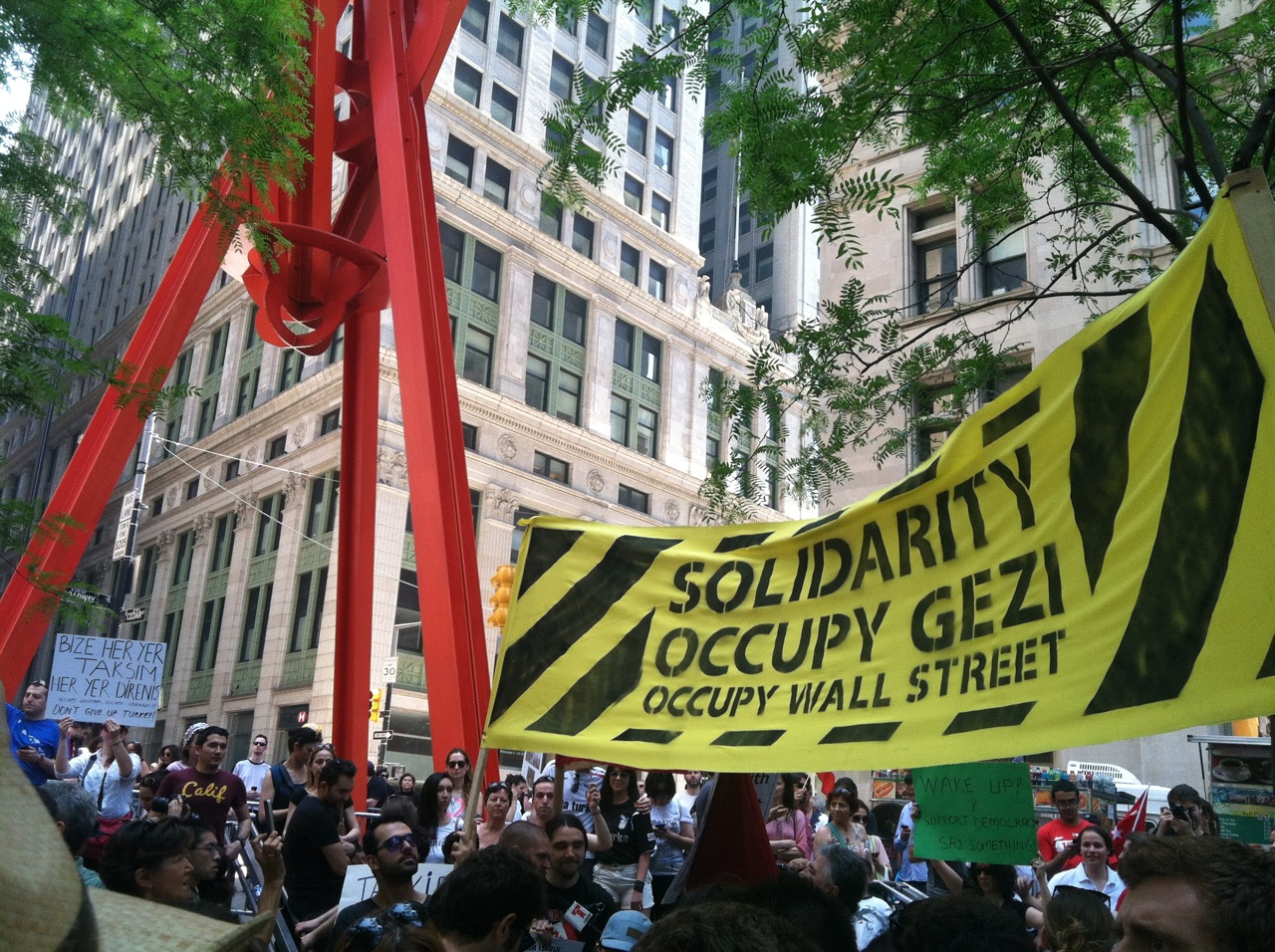
Last Saturday I attended the Occupy Homecoming in Liberty Square. I had heard ahead of time that there would be an “Occupy Gezi” solidarity rally happening in the park that day. I anticipated that the OWS presence might be light, aware that there was a Bradley Manning march at Fort Meade that same day, but I still thought the park would be filled with people. All of the solidarity rallies I have been to in the past have mobilized large numbers of folks from the local community. A common culture and a common language go a long way when trying to get people active, especially if their country has a history of popular protest. The familial dynamic, the ability to come together as sisters and brothers, that I have witnessed in many other cultures doesn’t comfortably fit into the core American identity. Declarations of United We Stand are common in times of hardship, and we have seen acts of tremendous empathy in response to natural disasters and other tragic events in recent years, but the core American identity continues to prioritize competition and self reliance over solidarity. In an earlier post I wrote about how the emphasis on independence and personal liberty has created a kind of “culture of doubt,” where people find it necessary to strike a defensive posture even when they are in agreement with others. Many of the conversations I had on Saturday dealt with this dynamic. Seeing the Turkish people come together so strongly had many asking why it was difficult to create similar dynamics here in the US among the 99%.

It got me thinking about the mythical guy (does this guy really exist?) who is outraged that he has to push 1 to continue in English. In fact, most of those phone systems no longer ask you to push a number at all, but you may be forced to pause momentarily to listen to someone ask Spanish speakers to push numero dos. Ok - stop for a moment - think about this. We live in a society that prides itself on being a “melting pot,” with a national motto of e pluribus unum (out of many - one), and yet we cannot seem to recognize this momentary pause as a simple courtesy extended to one of the many cultures that make up this rather amazing place. When I see the folks that speak Spanish as my sisters & brothers, this pause is not an inconvenience, but a teeny tiny little acknowledgement that they are just as welcome, valued, and essential in this country as I.

On Saturday the Turkish people in Liberty Square were chanting and singing mostly in Turkish. I took it upon myself to inquire from people I was standing near what some of the chants were, and what they meant in English. When a number of flags were raised and the crowd cheered I found out that the fans of rival teams that usually fight it out on the football field, had come together as Istanbul United to fight police brutality. It was amazing to me that everyone seemed familiar with each of the many songs that were sung. I found out that many of the songs were modeled after football chants/songs that were commonly known, that words were substituted using the same melody, and some were even sung verbatim. On the following day an effort was clearly made to do more chants in English and I availed myself of the opportunity to participate more fully.


Photo by Mickey Z.

I felt that the solidarity rally taking place in Liberty Square was both a tremendous acknowledgement of the significance of that space and of OWS, as well as a wonderful opportunity for us to connect with and learn about the people at the heart of another occupation. While the evidence of solidarity was clearly visible in the crowd that had gathered as well as in the SOLIDARITY - OCCUPY GEZI / OCCUPY WALL STREET banners that were present, the rally never seemed to me to coalesce fully. I don’t believe that it was about willingness to participate as much as it was a function of the ability to participate. As I mentioned above, solidarity is easier when you speak the same language. At one point a young man approached some folks I was talking with concerned that there was a right wing sign near one of the OWS banners. He thought there was the possibility that a photo of this could create the impression of an OWS endorsement of the message on this sign. He proposed moving all of the OWS banners away from the main group of Turkish people to avoid this. I asked him if he read Turkish - if he had read the sign in question. He replied that he had heard this information from someone else. The OWS banners, mostly held by the Turkish people themselves were not removed from the group, but I mention this is an example of how the language barrier can potentially limit our ability to connect. Mic check and move check were on my mind after writing about them in my last post, and I wondered why someone (including myself of course) didn’t mic check to welcome the Turkish people to Liberty Square, to express how powerful it was to be there in solidarity with them and the people in Turkey. I had hoped that participating in a mic check with the Turkish people might provide us a way to develop a deeper connection, to build empathy through internalizing the feelings that came up. Perhaps this happened earlier when I wasn’t in the park, or perhaps it happened between individuals, but even when we later bridged to the People’s Assembly, I felt that we were largely missing out on hearing and speaking (through mic check) the voices of the Turkish people present.

The People’s Assembly began with music, song, and an informative performance about Monsanto and GMOs by The People’s Puppets. Afterward a man got up and mic checked (paraphrasing here) that music and puppets were fine & entertaining, but that we needed to be more serious about the issues at hand. After he spoke another man mic checked that his family had been part of what he referred to as a “singing revolution” in Estonia. I believe that the inclusion of expressive performance at the beginning of the assembly was both an attempt to make the segue into the assembly go more smoothly, as well as an attempt to speak in language that was not simply based in words. There it is again - language. Translation. On a day that was filled with song and chants in Turkish, here we were encountering resistance to another language, a language based in artistic expression rather than linguistic precision. Do we all speak the same language? How can we express our solidarity even when we don’t? If we are in fact building a culture of resistance (as opposed to the fore mentioned “culture of doubt”), how can we be more mindful not to misdirect this resistance toward our sisters and brothers?


 Photo by Phoebe Berg
 
Tomorrow (Saturday), June 8th, there will be another Solidarity Rally in Liberty Square beginning at 12pm. March to Times Square scheduled for 4:30. Everyone is invited!

___

POST MARCH UPDATE - The rally and march on Saturday was well attended and well received. A powerful and beautiful showing of solidarity by all involved! Chanting “Resist Turkey - You are not alone!” “Resign Erdogon!” and “The people united will never be defeated!” we marched from Liberty Square to Union Square. At both Liberty and Union Square mic checks were done in Turkish and English so everyone could participate fully. Earlier on Sunday a Greek contingent joined the rally at Liberty, warmly greeted with loud cheers from the Turkish people. When people who have been made to distrust one another can come together, to recognize their common struggles and common aspirations: for freedom, for justice, for peace - the people united will never be defeated.

Check out these beautiful photos by Resa Sunshine of Saturday’s rally and march.

Monday, April 15, 2013

PAYING FOR WAR

When I wrote Are we courageous enough to face the why? I was responding to how we categorize those who take actions we find unfathomable as “crazy,” their actions as “senseless.” In the wake of the Sandy Hook tragedy I have read, and responded to article after article that simplify the larger issue of violence in our society (and the world) to a singular conflict over “gun control.” Each side of the conflict seems quite content to call out the opposition as “extremist,” “out of touch,” etc. Despite the enormous amount of attention dedicated to the issue, I can count on one hand the number of times I have seen the weapons industry and gun manufacturers referenced in connection to the NRA and other gun advocacy groups. Instead the emphasis has been on the outrageous “polarizing” comments of individuals, and the “fringe” interests they represent. The rhetoric on both sides seems to have so many common terms it’s becoming progressively unclear to me just who owns this conflict narrative. There are, however, several things that do seem clear to me. Presenting the narrative as a conflict ultimately serves to reinforce the perception that gun owners are under attack, and strengthens any defensive argument the gun lobby makes. The righteous indignation that follows serves as validation of what I believe is essentially a coldly calculated business decision. Seen from this perspective the “extremism” is actually quite sensible: the more guns on the streets - the more violence we see - the greater our fear - the more weapons are sold. Any regulation of guns amounts to a restriction of gun sales, and less guns sold means less weapons industry profit. I am not implying that this business decision is an ethical one, but it is a rational one, and our insistence on categorizing it as extreme, crazy, senseless is only providing cover for an industry acting in its own best interest.


The other conflict dominating the news? Proposed Social Security and Medicare cuts to stem the deficit “crisis.” Similarly here, “extreme” positions mask the underlying dynamics. I do hear some talk about the deficit being a function of lost tax revenue due to massive cuts for the rich (and straight up tax evasion) coupled with high unemployment (of folks who would otherwise be paying taxes on their income). What I rarely hear is a critique of the wholesale looting of the treasury that has been pulled off by private “defense” contractors and... you guessed it... the weapons industry. Possibly a passing reference to the costly execution of two wars, the waste and mismanagement (“incompetence”), but never an actual indictment of war profiteers themselves. In Money Out of Politics, I brought up the specter of corporate leadership buying into office and then legislating for their own profit. Borrowing from the Social Security Trust Fund to pay for the Iraq War and then sounding the alarm on program insolvency should raise a little skepticism over the sincerity of those who are clearly looking to cash in on these programs through privatization. Like “gun control” the issue will be tethered to the big government/small government (no government) narrative, but again this is only to inspire outrage and provide cover. The actual objective is to funnel government money, and ultimately the resources of our people, into the coffers of a select few. Until we free ourselves from the illusion of separation between the corporate elite and “our” government leaders, the prevailing idea that politicians are merely influenced by lobbyists and not directly connected to the corporations themselves, we will continue to be trapped inside their scripted narrative. As I wrote in Visions of Peace, “As weapons dealer to the world and our own best customer, is it any wonder that American cultural promotion of war (violence, conflict, competition) is second to none?”

Tax day. How much are you paying for war?
___

Take Action - Global Day of Action on Military Spending
___

Related articles:
The Atlantic - Paying the Costs of Iraq, for Decades to Come
Reuters - Iraq war costs U.S. more than $2 trillion: study
Tom Engelhardt - The Enemy-Industrial Complex

Saturday, October 13, 2012

“I take your stuff...”

On the weekend of the Occupy Wall Street anniversary I attended a meeting of the Strike Debt assembly in New York. The meeting was a book release for The Debt Resistors’ Operations Manual, but also a working meeting to get input from all that attended. At the onset of the meeting a couple of people shared their personal stories of debt with the group. This sharing of stories was intended to address the shame, frustration and fear that many feel in connection with their debt. I could understand the logic here, but I found myself having a very strong reaction to the idea of shame being a common reference point for our discussion of debt. I wanted to share my story, but I didn’t think it fit within this construct. I’m in debt, but it is not shame that I feel, it is outrage. I don’t buy into the common American debt narrative: you are in debt because you bought something you couldn’t afford, because you were living beyond your means, because you are lacking in personal responsibility, because you are lazy, etc. The underlying idea here is that debt is a product of choice. But debt is about much more than choice, it is a deliberate and coercive means of control.

After several people involved with Strike Debt had spoken about different aspects of the project, a facilitator asked us come up with a question concerning debt to be posed to the group. I wasn’t really sure how to frame my question, but I was eager to offer my input and get some feedback. So when the mic came around to me I asked, “How does debt relate to theft of resources by 1% corporations?” When corporations go into countries and steal resources to sell them on the global market, often back to those they originally stole them from, how does this relate to debt? The facilitators wrote down the questions people had posed, inviting us to break out into smaller groups and choose one of the questions to discuss. The group I was part of was interested in discussing several of the questions, one participant even adding a question of her own to the list. A few people in the group were particularly interested in the question I had posed and asked me to elaborate on it. I appreciated their interest and enthusiasm, but at the time I felt reluctant to do so. I was much more interested in engaging in dialogue and listening, than in elaborating on my question. Deference to leadership is common within our culture, a show of respect for those who appear knowledgeable and capable (or, in seeming contradiction to the origin of this nation, are divinely appointed). When this is coupled with individual ownership of ideas, another root tenet of our culture, it can be difficult to contribute to a conversation without appearing attached to the ideas one contributes. But if we are truly looking to evolve “our” ideas, and not simply own the soap box, perhaps we should be seeking to free them from ownership, to let them exist independent of individual ego and belief, to invite and encourage modification of the ideas through alternative perspectives.

When it comes to movement building I have always been a big proponent of broadening our focus to include allies internationally, to more objectively understand and address the obstacles we face, as well as to learn and share successful strategies for moving forward. While focusing on a single issue may seem like good strategy for mobilizing a specific group of people affected by and passionate about that particular issue, it can also create a kind of tunnel-vision, blinding us to the broader interconnectedness of multiple issues affecting our larger community. Similarly, we can become trapped inside our own cultural identities, unable to recognize that many of the obstacles we face are a function of these identities. Inclusion of alternative perspectives, free of this cultural bias, can often allow us to see past these obstacles.

International debt relief has been a focus of the global justice movement for many years, but that concept of debt appears quite different from the American (USA) model. It occurs to me that the major difference here is this American illusion of “choice.” When a Bolivian farmer is made to choose between paying for water or feeding his family - is this really a “choice”? When our seniors are made to choose between heating their homes or medicine to keep them alive - is this really a “choice”? When our youth are made to choose between getting an education or supporting their families - is this really a “choice”? All of these “choices” have something in common: resources that have been privatized and then sold off to make a profit. The corporations and financial entities (and governments that empower them) that have privatized (stolen) these resources have no intrinsic right to them, though they often receive public subsidies to extract and/or refine them. We are so indoctrinated into a system of individual ownership in the US, the very concept of “property” enshrined in our Constitution, that we can scarcely conceive of the commons belonging to us. When we provide our labor, why do we not conceive of it as a resource? When we speak of success, why is it not as a function of the combined labor (physical and intellectual) of those who have come before us? When the air, water and land we need to live is jeopardized by corporate abuse, why do we not simply take it away from them? Even our genetic information, the very mystery of life itself, is but another resource to privatize and commodify. Key here is that, once the resources have been extracted, the people will require assistance to make up for the loss to their economies, their livelihoods, their ability to provide for their people’s basic needs. And, as if on cue, in swoops the benevolent benefactor (you know - the same one that stole all your stuff moments ago) to generously provide that needed assistance - at a price...

So how can we recast this American debt narrative of “choice” to be more in line with the one that is known throughout the world? One person in our break out group suggested that we might come up with a sort of overarching metaphor, something to cut through all the complicated financial bs that insulates debt from critique. I mentioned something about native cultures’ conception of land as communal, a gift from the creator, rather than as some thing to be owned. It got me thinking that a deeper look at the concept of ownership itself might be helpful when examining debt. As the break out groups were called on to report back to the larger meeting, I quickly jotted this down in my notebook:

I take your stuff, then I make you pay for it. I take the lion’s share then I make you fight for the crumbs. Then I offer you a “loan” to make up for your loss. Then I sell your debt/use it to make even more money.

I’m not an expert in finance or debt. I have a BFA, not an MBA. But swimming in this financial cesspool of intentional obfuscation, perhaps more expert testimony is not what we need. Perhaps a bit of intuitive common sense instead. When the banking/brokerage kings of finance are allowed to sell 30-40 times more debt (most of it in bundled home mortgages) than they can back up with actual cash money (liquid assets), turning profit on every sale along the way, knowing full well that our taxes will bail their asses out when the junk debt they’re selling goes belly up; maybe we need to be looking beyond the paltry sums that we “owe” them - to the massive amounts of profit they make dealing “our” debt. Whatever we decide to focus on, we should keep in mind: it is only through our common consent to their hoarding of our resources, that we remain indebted to them.
___

Today we will be meeting, marching, and MAKING SOME NOISE in New York and across the world. Perhaps you will join us wherever you are :)
___

I wrote a bit about the 1% austerity model in a related post here

Friday, August 3, 2012

MONEY OUT OF POLITICS?

For years now we’ve heard about corruption in politics, the influence of lobbyists, and the incompetence of politicians; but the Citizen's United decision and the election year cycle seem to have focused this dialogue more tightly. I am reading and hearing a single idea repeated over and over; it is essentially a concession that politicians must now do the bidding of their corporate sponsors or risk losing the funds necessary to win their respective elections.

Over the course of the Obama presidency this idea has evolved into a rationale for the passage of policy that the majority of people in the country do not want. Under threat of negative advertising and withholding of campaign contributions, politicians cast themselves as hapless victims of a system they have no control over. This relieves them of responsibility for the bad decisions they are forced to make. It is particularly disturbing to hear supporters of these candidates reduce their own critique to repetition of a variation on the single phrase, “What would you have them do? Their hands are tied.”

Americans* pride ourselves on our great empathy for others who are powerless to change their own circumstance. When our politicians present themselves as powerless to change the direction the country is headed, it is intended to resonate with our feelings of powerlessness in our own lives. Whether they feel your pain or they “know that times are tough,” they are recognizing your feeling of powerlessness and then relying on your empathy to validate their own appearance of powerlessness. If this is not an intentional fabrication, it is certainly a convenient one.

It occurs to me that by omission or by design, this powerlessness argument seems to miss two important points.

First, a growing number of our political officials are not simply under the influence of moneyed interests, but are in fact directly connected to the corporations that their policy decisions will affect; as former CEO's, major share holders, etc. Put simply, this is corporate leadership buying into office and then legislating for their own profit. I saw this in spades during Bush & Company's reign. Dick Cheney was CEO of Halliburton from 1995-2000, when he became Vice President. Halliburton received numerous no-bid contracts in connection with the Iraq War. The argument could have been made that the war was one for profit, but the media was seemingly too distracted by fictitious Weapons of Mass Destruction to investigate or even comment on this. Though Americans would support their President in defending the country, and even support defense contractors for a job well done, they might have had a different perspective if informed that those that stood to profit from the war were the same people that made the decision to go to war. Wholesale looting of the United States Treasury for private profit doesn't poll very well with voters.

Second, why don’t we have higher expectations of our political officials? On the campaign trail it is all “fight fight fight,” but why don't we expect them to act courageously on our behalf once they are in office? When they constantly reiterate the obstacles they face, no one asks them flat out what plans they are developing or what options they have for overcoming these obstacles. Isn't this their job after all? Why do we elect them/continue to elect them if they seem incapable of solving (or is it unwilling to solve) the problems we face? If you go to a demonstration and the society doesn't change the next day, you don’t just go home and give up. You have to be creative and come up with other ways of moving forward. If the authorities break up your protest, you can’t start using that as an excuse not to protest. It’s a self fulfilling prophecy. In Wisconsin the opposition senators left the state to keep the senate from achieving the necessary quorum to vote. They stood with their constituents and took action rather than spending time making excuses. What options do our political officials have available to them to solve the problems we face? Ask them if you don't know, tell them if you do, and above all talk to each other and come up with your own solutions.
___

*I am using this term here to refer to those living in the USA, not to reference all of our sisters and brothers in the Americas.