Showing posts with label OWS. Show all posts

Friday, June 7, 2013

DAYANIŞMA / SOLIDARITY

Diren Gezi is Gezi Resistance. Taksim (Taksim Gezi Parkı) is the park that is being occupied in Istanbul, Turkey. Not to be confused with Tayyip (Recep Tayyip Erdoğan), who is the Turkish Prime Minister. Tayyip Istifa! is a chant for him to resign. Çapuling is chapulling. If you are unfamiliar with the word chapulling, that is because it is a new word. Tayyip (remember him?) has taken to calling the demonstrators ayyaş (alcoholics) and çapulcu (looters). Rather than defend against this, the demonstrators chose instead to reappropriate the term çapulcu. The urban dictionary defines the term as “to resist force, demand justice, seek one’s rights.” The term “looters” shouldn’t be unfamiliar to us here in the US. We have heard it and other similar terminology used time and again to dismiss the legitimate concerns of people in need and those that rise up against social and economic injustice. In the aftermath of Hurricane Katrina the US news media was rife with stories casting desperate victims of Katrina as marauding bands of “looters.”

Last Saturday I attended the Occupy Homecoming in Liberty Square. I had heard ahead of time that there would be an “Occupy Gezi” solidarity rally happening in the park that day. I anticipated that the OWS presence might be light, aware that there was a Bradley Manning march at Fort Meade that same day, but I still thought the park would be filled with people. All of the solidarity rallies I have been to in the past have mobilized large numbers of folks from the local community. A common culture and a common language go a long way when trying to get people active, especially if their country has a history of popular protest. The familial dynamic, the ability to come together as sisters and brothers, that I have witnessed in many other cultures doesn’t comfortably fit into the core American identity. Declarations of United We Stand are common in times of hardship, and we have seen acts of tremendous empathy in response to natural disasters and other tragic events in recent years, but the core American identity continues to prioritize competition and self reliance over solidarity. In an earlier post I wrote about how the emphasis on independence and personal liberty has created a kind of “culture of doubt,” where people find it necessary to strike a defensive posture even when they are in agreement with others. Many of the conversations I had on Saturday dealt with this dynamic. Seeing the Turkish people come together so strongly had many asking why it was difficult to create similar dynamics here in the US among the 99%.

It got me thinking about the mythical guy (does this guy really exist?) who is outraged that he has to push 1 to continue in English. In fact, most of those phone systems no longer ask you to push a number at all, but you may be forced to pause momentarily to listen to someone ask Spanish speakers to push numero dos. Ok - stop for a moment - think about this. We live in a society that prides itself on being a “melting pot,” with a national motto of e pluribus unum (out of many - one), and yet we cannot seem to recognize this momentary pause as a simple courtesy extended to one of the many cultures that make up this rather amazing place. When I see the folks that speak Spanish as my sisters & brothers, this pause is not an inconvenience, but a teeny tiny little acknowledgement that they are just as welcome, valued, and essential in this country as I.

On Saturday the Turkish people in Liberty Square were chanting and singing mostly in Turkish. I took it upon myself to inquire from people I was standing near what some of the chants were, and what they meant in English. When a number of flags were raised and the crowd cheered I found out that the fans of rival teams that usually fight it out on the football field, had come together as Istanbul United to fight police brutality. It was amazing to me that everyone seemed familiar with each of the many songs that were sung. I found out that many of the songs were modeled after football chants/songs that were commonly known, that words were substituted using the same melody, and some were even sung verbatim. On the following day an effort was clearly made to do more chants in English and I availed myself of the opportunity to participate more fully.


Photo by Mickey Z.

I felt that the solidarity rally taking place in Liberty Square was both a tremendous acknowledgement of the significance of that space and of OWS, as well as a wonderful opportunity for us to connect with and learn about the people at the heart of another occupation. While the evidence of solidarity was clearly visible in the crowd that had gathered as well as in the SOLIDARITY - OCCUPY GEZI / OCCUPY WALL STREET banners that were present, the rally never seemed to me to coalesce fully. I don’t believe that it was about willingness to participate as much as it was a function of the ability to participate. As I mentioned above, solidarity is easier when you speak the same language. At one point a young man approached some folks I was talking with concerned that there was a right wing sign near one of the OWS banners. He thought there was the possibility that a photo of this could create the impression of an OWS endorsement of the message on this sign. He proposed moving all of the OWS banners away from the main group of Turkish people to avoid this. I asked him if he read Turkish - if he had read the sign in question. He replied that he had heard this information from someone else. The OWS banners, mostly held by the Turkish people themselves were not removed from the group, but I mention this is an example of how the language barrier can potentially limit our ability to connect. Mic check and move check were on my mind after writing about them in my last post, and I wondered why someone (including myself of course) didn’t mic check to welcome the Turkish people to Liberty Square, to express how powerful it was to be there in solidarity with them and the people in Turkey. I had hoped that participating in a mic check with the Turkish people might provide us a way to develop a deeper connection, to build empathy through internalizing the feelings that came up. Perhaps this happened earlier when I wasn’t in the park, or perhaps it happened between individuals, but even when we later bridged to the People’s Assembly, I felt that we were largely missing out on hearing and speaking (through mic check) the voices of the Turkish people present.

The People’s Assembly began with music, song, and an informative performance about Monsanto and GMOs by The People’s Puppets. Afterward a man got up and mic checked (paraphrasing here) that music and puppets were fine & entertaining, but that we needed to be more serious about the issues at hand. After he spoke another man mic checked that his family had been part of what he referred to as a “singing revolution” in Estonia. I believe that the inclusion of expressive performance at the beginning of the assembly was both an attempt to make the segue into the assembly go more smoothly, as well as an attempt to speak in language that was not simply based in words. There it is again - language. Translation. On a day that was filled with song and chants in Turkish, here we were encountering resistance to another language, a language based in artistic expression rather than linguistic precision. Do we all speak the same language? How can we express our solidarity even when we don’t? If we are in fact building a culture of resistance (as opposed to the fore mentioned “culture of doubt”), how can we be more mindful not to misdirect this resistance toward our sisters and brothers?
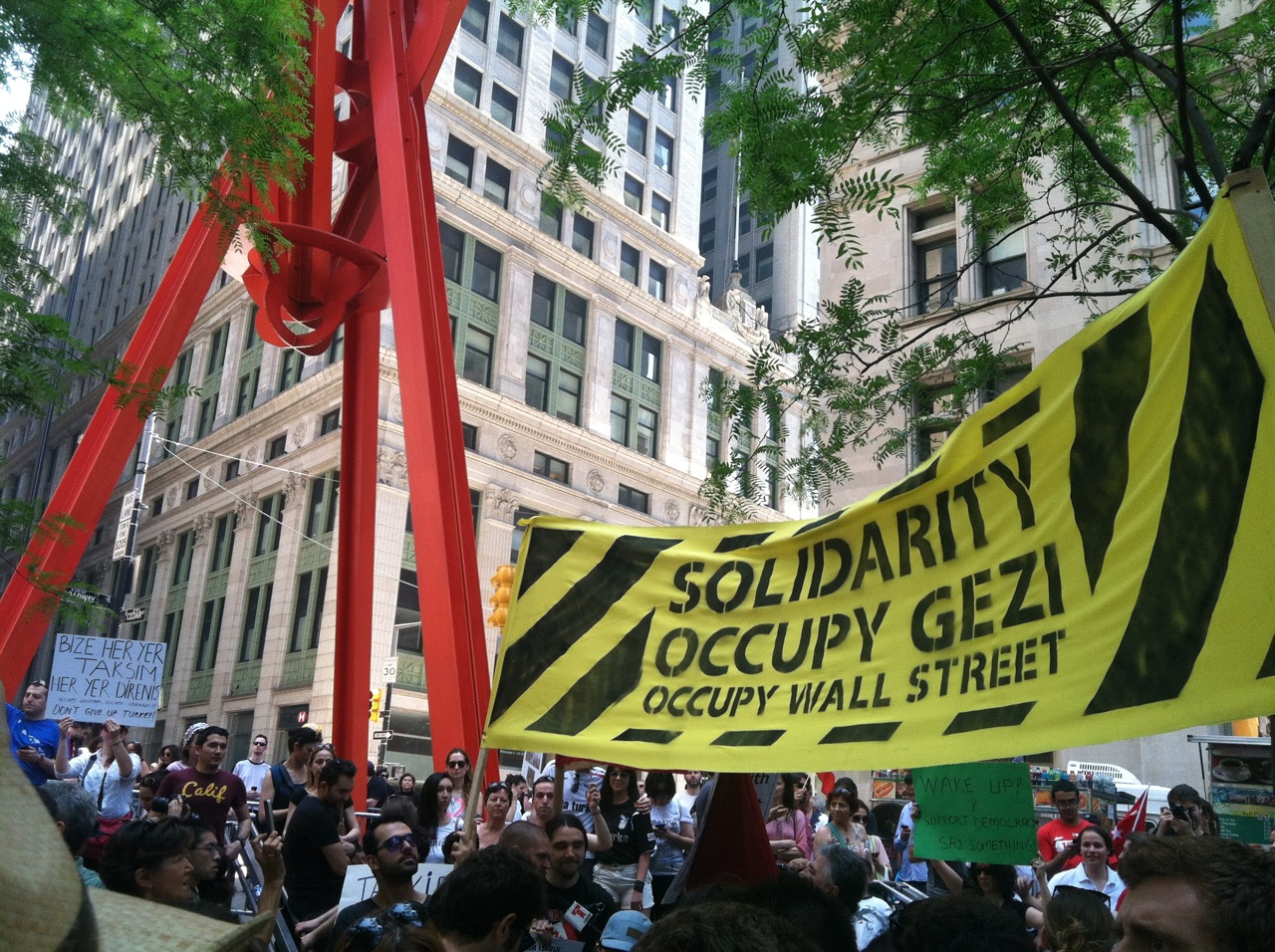

 Photo by Phoebe Berg
 
Tomorrow (Saturday), June 8th, there will be another Solidarity Rally in Liberty Square beginning at 12pm. March to Times Square scheduled for 4:30. Everyone is invited!

___

POST MARCH UPDATE - The rally and march on Saturday was well attended and well received. A powerful and beautiful showing of solidarity by all involved! Chanting “Resist Turkey - You are not alone!” “Resign Erdogon!” and “The people united will never be defeated!” we marched from Liberty Square to Union Square. At both Liberty and Union Square mic checks were done in Turkish and English so everyone could participate fully. Earlier on Sunday a Greek contingent joined the rally at Liberty, warmly greeted with loud cheers from the Turkish people. When people who have been made to distrust one another can come together, to recognize their common struggles and common aspirations: for freedom, for justice, for peace - the people united will never be defeated.

Check out these beautiful photos by Resa Sunshine of Saturday’s rally and march.

Thursday, September 20, 2012

To PVC, or not to PVC, is not the question.

I could not have been in Washington Square Park for five minutes when I was surrounded by police. On Saturday I attended the Occupy Town Square, arriving late in the afternoon. The Park was filled with people: occupiers, people there for the folk festival, and the general public. When I arrived I approached a friend who was lending a hand bracing the OTS banner on a breezy day. Our conversation was interrupted when a Parks Department official came up and told my friend that pvc (plastic) tubes were not allowed and “asked” him how long it would take to switch the pvc for cardboard tubes. I put ask in quotes here because it didn't actually sound like a question at all, but more like a threat. The three Parks Department officials were accompanied by a rapidly growing circle of NYPD officers who said nothing during the initial exchange, but moved in rapidly to surround the banner and the few people that were near it, myself included. As the circle of officers grew tighter, it was apparent that they were not looking to patiently wait for the pvc tubes to be replaced, but were simply using the non-issue as a means to escalate the situation - likely to provide a rationale for suppressing the entire event. Needless to say, it is rather alarming to be in the park talking with a friend and then to find oneself suddenly surrounded by police officers. It is especially alarming when the police seem to be silently enacting some preplanned strategy that does not involve actually communicating to you what it is that you have done to warrant this treatment. I took the opportunity to step outside of the circle when it presented itself, realizing that I might be subject to arrest just for standing where I was.

Having been a banner wrangler in the past I was familiar with the claims being made about the pvc tubes. The tubes themselves are not illegal. According to the NYPD, “the carrying of signs or objects at a demonstration is protected First Amendment activity. However, where it can be shown that the object carried, i.e. a wooden pole with a sign attached or a bat, (italics mine - a bat?!) has the potential for being used as a weapon, the police may prohibit the carrying of the object during the demonstration. Persons who insist on carrying objects that are potential weapons should be directed to put the object down and leave the area of the demonstration. If they refuse to do so and continue to congregate with others in the demonstration, they may be arrested for Disorderly Conduct, Penal Law Section 240.20.” Clearly, the OTS banner is NOT a weapon, nor is it a structure that would violate the Parks Department’s prohibition on “unlawful camping.” Reading through the current rules and regulations concerning the regulated uses of the NYC parks, it would seem that our constitutional right “peaceably to assemble” now requires the permission of the parks Commissioner when we chose to exercise it in our city parks.

Once away from the circle, I decided to mic check to the crowd as I was particularly struck by the absurdity of the situation, and hoped that shedding some light on it while it was occurring might raise the awareness of folks in the park. Some occupiers seemed upset when I was vocal about the situation, perhaps recognizing that this engineered conflict was a distraction and not wanting us to focus on it. My concern was that people, particularly those outside of OWS, should know why the police action was being taken - that it was not really about plastic tubes, but about the suppression of OWS.

Back in February of 2002, I was stopped by NYPD on the sidewalk when leaving a demonstration focused on the World Economic Forum that was happening in NYC that year. I was blocks away from the demonstration when I saw two officers that had been deployed to protect a nearby Starbucks. One of the officers demanded that I surrender the cardboard tube that my sign was stapled to. I asked them what would happen if I did not, and they told me that I would be detained until their superior arrived, and that he would decide what to do with me. I removed the tube (one of hundreds I had purchased months earlier) from my sign staple by staple as the officers looked on, and surrendered it to them. I lifted my sign high above my head as I walked down the block. I recall thinking about the police busily confiscating all of the x-mas wrapping paper that must have flooded that entire area of the city just a few weeks back, and how absurdly selective this confiscation of my property was.

So big deal. It’s just a tube. Why is this so important to me? Well, it’s easy to recognize that the police presence, tactics, actions are intended to intimidate protestors; but I believe community intimidation to be the real focus of these overwhelmingly disproportionate displays of force. These police spectacles are staged over and over at Occupy events, an over reaction to fabricated danger that is simply not present at these events. In a self-validating cycle, it is the police presence itself that creates the appearance of a conflict that they must then police. The 1% are aware just how unpopular their policies are, and the consistent repetition of their “occupiers clash with police” mantra (delivered through their corporate media) is meant to discourage others from joining the movement. While OWS works to broaden the movement and make protest more accessible - the NYPD is tasked with forming a barrier between OWS and the community; via police lines, barricades, vehicles, etc. The implied message is “if you join these folks in protest, you may be subject to arrest.” The heavy police presence can be alarming to those of us who are not faced with it every day in our communities. For those at greater risk of arrest, deportation, etc. these patterns are all too familiar; but the choice to run the gauntlet, when NYPD has been deployed as a barrier to participation, cannot be an easy one to make. It’s a set up. The 1% want you to believe that in order to join the movement, you have to be willing to breach that barrier, to risk arrest. But this is a distraction - the police should not be the focus of Occupy, a manufactured conflict to siphon off our creative energy. The NYPD officers are by definition part of the 99%, being played as pawns to protect the king. It is up to us to stay focused and not let the one percent use us in a similar fashion.

Over the last year we have heard numerous statements by the Secretary of State and even the President himself concerning protection of freedom of speech and freedom of assembly in Egypt, Syria, Libya, Iran, Russia, etc. but they have been entirely mute when it comes to the crackdown on those same freedoms here in the United States. It was Chicago Mayor Rahm “Rahmbo” Emanuel that presided over the arrest of more than 300 Chicago occupiers during the shut down of their encampment. I called the White House to inquire when the President would be contacting his former Chief of Staff, to ask him why people were being arrested for exercising their 1st Amendment rights. Not surprisingly - they had no answer for me. Within a matter of weeks numerous occupations that had sprung up all over the US (and the world) were systematically shut down one by one, with New York, Oakland, Oregon, Denver, and Zurich forcibly cleared in a single night. When folks talk about the demise of Occupy and/or its disappearance from the headlines, it seems like such nonsense to me - like a self fulfilling prophecy. When the main stream media shows up to a demonstration hours after all the demonstrators have been forcibly removed and claims that the demo is a dud because no one showed up, do you buy what they are selling you? When a New York City Councilman is shoved by NYPD three times at the OWS one year anniversary, do you hear about it on the news? When another New York City Councilman was roughed up and arrested during the raid on Liberty Square, does Mayor Bloomberg / Commissioner Kelly apologize? With over 7000 US Occupy activist arrests, some 2,500 in NYC alone, when will our government address the issue?

The Wisconsin protests last year are a powerful example of what is possible when people stand in solidarity and can see past the political double speak of 1% politicians. The outcome of the recall effort reminds me of those “self fulfilling prophecies” hurled at Occupy. A thirty million dollar Walker war chest was countered with lukewarm support from the DNC and a hours before election day tweet of support from the President. Despite all the talk of community and grassroots organizing in the 2004 Obama campaign, it seems pretty obvious that supporting a recall made possible through popular protest was just not a priority. A victory that might embolden people to think they can actually make the “change” themselves might not be the best strategy for an incumbent in an election year, especially if you have to share that year with Occupy... One of the things that stood out to me about the Wisconsin protests was the bridge that was formed by the participation of the local police. The Madison police were there in solidarity with their union brothers and sisters, but they could speak to their fellow officers in the Capitol Police as brothers and sisters as well. So is it somehow possible to duplicate this kind of bridge in NYC, to lessen the grip of the 1% on New York’s Finest? A few weeks back I asked a friend from Wisconsin what it would take to get the local Madison police officers out here to march with OWS, today I read a joint statement from the Madison Professional Police Officers Association and Dane County Deputy Sheriffs Association: “The right to free speech and the right to peaceful assembly are two of the fundamental rights upon which our democracy is based. Since the birth of our nation, the courts have taken great pains to protect these rights vigorously, and view any infringement upon these rights with great skepticism. We believe the recent enforcement action at the Capitol clearly violates these rights in a way that should be unacceptable in a free society.”

Read the statement in its entirety here
___

OWS never got that apology from Bloomberg and Kelly, but there is this
 

Wednesday, August 22, 2012

OTHER OBSERVATIONS ON (FOR) OCCUPY

The first thing I noticed when I became involved with the OWS movement was that it had an intuitive quality that I had not seen in other organizing I had been part of. In my past organizing I often found myself championing some specific point or other that I felt was so utterly essential to the success of the action being planned. I worried that we might be missing yet another opportunity if these specific points were overlooked. My feelings were certainly a function of the desperation I felt to stop the suffering that was being piled upon the world, but they were also tied to my belief that our actions could be more focused, more meaningful, and more widely received if we would only put that extra bit of forethought into them. When I started attending Occupy actions I noticed myself immediately starting to think along those same lines, “if only we… then our outcome might be…” But something was very different. I imagine my not being there from the beginning in organizing meeting after organizing meeting might have something to do with my perception, but it really felt like something new was happening. I started telling friends that Occupy was “self-correcting.” It’s hard to explain, but I found that whenever I noted some potential obstacle to the movement (and felt the accompanying feeling of urgency to remedy the situation) - I found that OWS as a whole seemed to recognize and remedy the situation before I could take any action myself. This intuitive quality allowed me to step back and not feel so desperate to be centrally involved.

So I find myself with a bit of an internal dilemma. I have such respect and gratitude for the tremendous scope and potential of OWS that I am often concerned about imposing my own limited perspective and perceptions on others within the movement. There is always the nagging thought - but what if I am wrong about this? But lately it occurs to me that if our collective intelligence (and intuition) are the core of our movement, then we really do need to be sharing our thoughts openly; not for the sake of ego, or for the sake of being right, but with the recognition that it is through the thoughtful participation of each of us that this movement grows and evolves. So I offer the following thoughts with love and mindfulness to my Occupy sisters and brothers.

The initial 1% response to Occupy Wall Street was to write us off as a bunch of do-gooder trust fund kids, who had nothing better to do than camp out complaining about our first world problems. The mass media mocked us saying that our use of smart phones and lap tops was proof that we weren’t really the disenfranchised poor that we claimed to be. The most common taunt heard near Liberty Square was “get a job.” I found the duplicity of these criticisms stunning, but these are just the most recent example of the us against them strategy deployed so successfully by the 1% (to strip young movements of their organizing power). When I was in College it was the “cultural elite” (hard to believe Dan Quayle came up with this one on his own) who were responsible for all of society’s ills. Under Reagan it was “welfare queens.” In Wisconsin it was the unions that were bankrupting the state. These fabricated conflicts are designed to misdirect the legitimate outrage of the people away from those actually responsible for our common oppression. And while we so righteously fight among ourselves, the 1% quietly (and often not so quietly) continue pillaging our labor, our resources, and our world.

So why are we so easily duped into this fabricated conflict? Well, I think it starts with a clever little bait & switch approach to our core identity as Americans.* At a very young age we are presented with a vision of our society firmly rooted in the concept of scarcity. Our own internal vision of our society (whatever that might be) is systematically replaced with this new vision that celebrates independence, competition, and the work ethic. The feeling of belonging and sense of purpose engendered through acceptance of these new ideas is a powerful motivation for impressionable young minds. This is the bait. The switch involves linking these new ideas and feelings to a new identity as “American.” I believe this to be the more significant step of our indoctrination, because while establishment of the core ideas is important, it is the implied threat of losing our new found feeling of belonging that steers us clear of critique and deviation from those ideas. And it is through this process that any suggestion of an alternative set of core ideas, in fact any critique at all, is easily cast as un-American, anti-freedom, etc.

Our adherence to these core ideas has manifested in some curious ways, each with it’s own internal mechanism for reinforcing the status quo. The emphasis on independence and personal liberty has created a kind of “culture of doubt,” where people find it necessary to strike a defensive posture even when they are in agreement with others. We have fetishized our freedom of choice to such an extent that the act of choosing takes precedence over questioning the choices we have been given. Within this framework, making up one’s own mind appears to be in direct conflict with any manner of collective decision making or collaboration. Setting out independence as a virtue unto itself does not allow us to evolve ideas or come up with alternatives through constructive dialogue and interaction, rather it instructs us to remain apart to avoid the undo influence of others who may want to change our opinion. The powerlessness that people feel in their lives further intensifies adherence to their existing beliefs - simple choices becoming noble causes to be defended at all costs. And herein lies the contradiction: while we are taught to value independence, our ability to think independently is crippled through strict adherence to the concept. With this wholesale rejection of dialogue, our ability to evolve our own ideas stagnates, and we are made dependent on the choices that are provided for us.

Similarly, when we are taught to value competition, we are not informed that a few select players will not be required to follow the rules of this game. These few players will be allowed to make off with the lion’s share of the treasure, leaving us to compete for the remaining scraps. Here again our adherence to the core idea keeps us paralyzed, so busy struggling to make ends meet that we have little time and even less resources to challenge the authority of those hoarding the wealth. When our President speaks of America “winning the future,” I find myself questioning - who will lose? This construct of winners and losers is meant to force our participation in the competition. After all, you can’t win if you don’t play; and if you don’t play, you will most certainly lose.

In my previous Occupy post I wrote “Inherent here is a recognition that the vast majority of the work we do is ultimately not for our benefit at all, but solely to produce profit for the 1%. And the 1% are relying on our tacit participation in order to continue to harvest the wealth from us.” The work ethic, like the values of independence and competition, is yet another strategy of self-enforced obedience. Like the other two, it is used as both carrot and stick. The carrot is the fabled American Dream - “if I work hard, I can make it.” The stick comes in the assertion that those who are unemployed, or do not work hard enough, are solely responsible for their own lack of success. It was this stick that was used over and over to berate occupiers at Liberty Square. It was intended to silence the truth that many occupiers actually had jobs, that many had actually sacrificed the security of having a job to be there, and that a large number were at Liberty specifically because they could not find work (or there was no work for them to find). For years I have heard the “get a job” taunt callously hurled at my homeless brothers and sisters, many of whom were now occupiers themselves. The irony was not lost on me. Witnessing thousands standing in solidarity, each with their own personal story, no longer simply demanding jobs but fundamentally questioning the value of the work ethic as a measure of our worth as human beings, the simplistic “get a job” retort seemed particularly absurd. As in Wisconsin the 1% were relying on the work ethic to supply the needed distraction. The 1% were counting on Wisconsinites to forget their common economic struggles and instead buy into a delusion casting union members as lucky beneficiaries of a free ride at the taxpayers’ expense. Rather than being encouraged to come together and find ways to make their lives better, the people are duped into jealously attacking any progress that their sisters and brothers have fought long and hard to achieve. 1% politicians (corporate fat cats that they are) cynically ask, “why should they have it so good while you suffer so?” They aim to stem rising anger throughout our nation and the world, strategically directing it back at any and all willing to stand up for the common good. Draining every last cent from the public trust in the process is a nice bonus.

Occupy Wall Street isn’t so easily duped into this ridiculous misdirection of our energy, or are we? Organizing from inside of our own culture it’s easy to take for granted all the conditioned beliefs that have been imposed on us. When we compare our actions in the US to the mobilizations of our sisters and brothers around the world, we must remember to take into account the specific hurdles that are intrinsic to our culture and not judge ourselves too harshly if we do not see identical results. It is good strategy to seek out transformative opportunities within the obstacles we face, but we must also bear in mind that the solution/resolution we seek may not be contained in the problem itself. The open model of OWS is a fantastic engine for new ideas, but we need not reinvent the wheel to address every challenge. Fear of co-option should not be allowed to assuage us from seeking allies, both domestically and internationally, with whom we can share and evolve successful tactics and strategies. We need not assist the 1% by echoing their messaging when defending against their attacks, our energy is much better spent creating and outreaching our own. The 99% is by definition going to include people at all different levels of social and economic strata, all with their own relative perspectives on the most pressing challenges for OWS, so how can we recognize and release our conditioned defensiveness so that we can address these challenges without habitually casting one another as perpetrators of the crimes committed against us? Perhaps if we can give up ownership of the identities imposed upon us, refuse to play the roles that have been scripted for us, we’ll be better able to see one another as sister and brother. Making our solidarity conditional to agreement on every detail, or to our individual experiences of oppression being equal, would be ultimately self-defeating. The us vs. them dogma that we have been fed all our lives needs replacing, but this time with the feeling of belonging that evolves quite naturally when we stop fighting for independence, stop competing for superiority, and stop working hard to get ahead long enough to take to the streets.
___

*I am once again using this term here to refer to those living in the USA, not to reference all of our sisters and brothers in the Americas.

Tuesday, July 31, 2012

OBSERVATIONS ON OCCUPY

This is a work in progress, a living document: a collection of my thoughts as they are today. I have come to this particular moment through the numerous conversations, dialogues and actions that I have participated in with my Occupy sisters and brothers over the last several months. My perspectives are also informed by the years that I spent organizing for peace & justice around the Iraq and Afghanistan wars and the parallel work organizing against Bush & Co. in all their “1%” guises. These thoughts rattle around my head incessantly and I am writing them up to add to the dialogue, to free them if you will. My hope is that others might evolve these ideas further, to help us all to grow the movement, to avoid repeating past mistakes, and to see opportunities where we might otherwise not think to look.

THE MODEL IS THE MOVEMENT

This observation seems pretty obvious to me, but I find that it is often misunderstood. I started using this phrase to get at the underlying irrelevance of the statement “what are their demands?” I don't think this was ever really meant as a question at all, but was simply presented as a rhetorical challenge to delegitimize the movement by labeling it as disorganized and lacking leadership. The news outlets that genuinely sought to report on the origins of the movement often sited the Adbusters poster which featured the headline “what is our one demand?” The headline was of course written prior to the occupation of Liberty Square and never actually adopted as a slogan of the movement, but for weeks it was used to hammer away at OWS as if it was a necessary prerequisite for a social justice movement to follow the rules set by the society that it was attempting to change. If reporters had taken the time to investigate the new organizational models that were being developed within OWS, they might have begun to understand how absurd the question of demands actually was.

Here's my take on it. Demands are rooted in the idea that someone has something that you want and if you negotiate with them they may give it to you. The collective bargaining process pits the leverage of the united workers against the interests of the managers (employers). In that model, management must respond to the demands of the workers to avoid a potential strike. Labor is similarly tethered to management because it is management that provides the salary and job to begin with. Though this is a perfectly sound organizing model, I don't see it as relevant to Occupy. I don't believe Occupy is particularly concerned with asking nicely for a piece of the pie or a fair share, but is focused rather on the complete withdrawal of our consent for a system that is designed to keep us enslaved. Inherent here is a recognition that the vast majority of the work we do is ultimately not for our benefit at all, but solely to produce profit for the 1%. And the 1% are relying on our tacit participation in order to continue to harvest the wealth from us. In order to be sustainable within this culture we are going to have to come up with viable alternatives to the current economic system.

So this brings me back to the model is the movement. Traditionally political movement goals were attained through the concessions of those in power. A traditional “solution” to the sub-prime crisis (housing bubble crash) might take the form of a tax applied to all derivatives. Isn't this essentially a tax on the profits made from you losing your home? Do you really want a piece of that pie? Are you satisfied with getting a little bit back of what was yours to begin with? An alternative solution could involve stopping the 1% from making pie out of your suffering. It is these kinds of alternatives along with strategies for their development and mobilization that emerge through the Occupy model. There is a recognition that the essential power of a 99% movement lies in the diversity of knowledge, experience, and passion of the people involved. Establishing movement goals before everyone comes to the table, would not take advantage of these strengths and could even create resistance from folks who felt they were not included in the process. The open dialogue of the people made possible through the local occupations and assemblies creates a real sense of connection. And in turn this experience of community builds compassion and understanding. Within this atmosphere, we can’t help but begin to move toward the sustainable alternatives we want. To paraphrase Jack Gibb in his book Trust, the “goals” are ultimately a by-product of the movement. It is the movement, the process itself, that is the product.